Metric conversion chart
The metric prefix ladder with the everyday metric equivalences on page 1, and metric to US customary conversions in both directions on page 2.
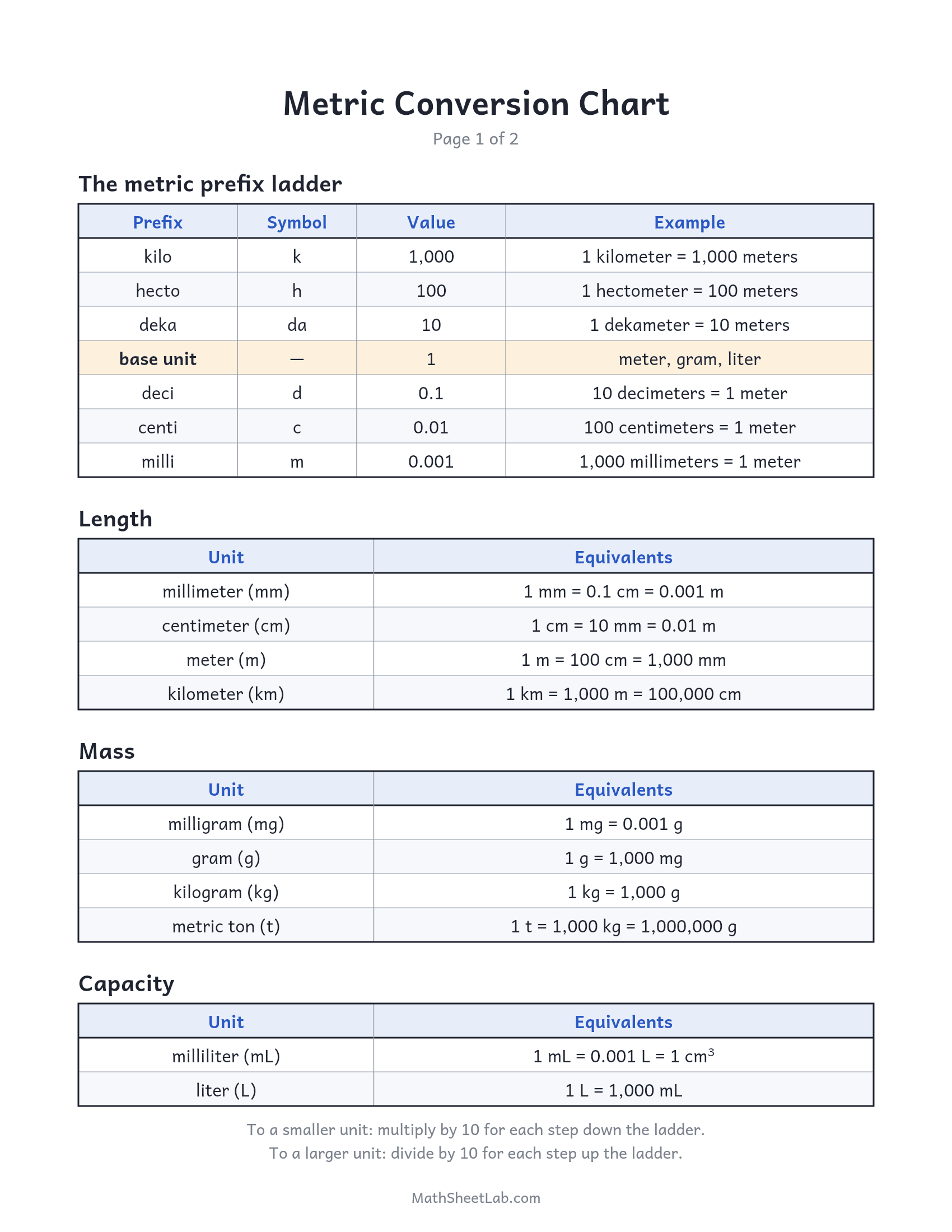
Both pages
Page 1 converts between metric units using the prefix ladder. Page 2 converts between metric and US customary units in both directions, with temperature formulas at the bottom.
-
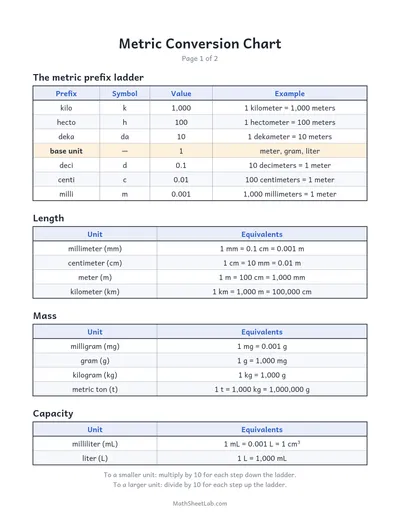
Metric to metric
-
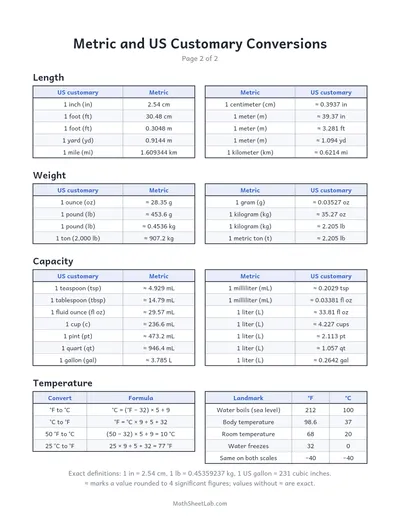
Metric to US customary
How to print it
- Open the print view. Press Print for a clean print-ready view of page 1, or download it as a PDF or PNG. The other pages are in the gallery below, with a button to download them all.
- Fit to page. In the print dialog choose “Fit to page” — the chart is laid out for US Letter and scales cleanly onto A4.
- Copy freely. Print or photocopy as many as you need for home, classroom or tutoring use. It is free, with no sign-up.
About the metric conversion chart
Metric units step up and down in powers of ten, so one ladder covers length, mass and capacity: kilo always means 1,000 and milli always means one thousandth, whatever the base unit. Page 1 is for the conversions 4th and 5th graders do inside the metric system, such as 3.5 km = 3,500 m. Each step down the ladder multiplies by 10, which is why the decimal point moves one place per step. Page 2 converts between metric and US customary units. Its values are computed from the legal definitions (1 inch is exactly 2.54 cm and 1 pound exactly 0.45359237 kg), and anything rounded is marked ≈.
Grade level: this chart is used in our 4th grade math worksheets and 5th grade math worksheets collections.
Frequently asked questions
How do you convert between metric units?
Find both units on the prefix ladder and count the steps between them. Going down to a smaller unit, multiply by 10 for each step; going up to a larger unit, divide by 10 for each step. Kilometers to meters is 3 steps down, so 4 km = 4,000 m.
Is there a trick for remembering the prefixes?
Many classrooms use “King Henry Died By Drinking Chocolate Milk” for kilo, hecto, deka, base unit, deci, centi and milli, from largest to smallest.
Are the US conversions exact?
Some are. The inch is defined as exactly 2.54 cm, so 1 foot = 30.48 cm and 1 mile = 1.609344 km with nothing rounded. Others, such as 1 kg ≈ 2.205 lb, are rounded to four significant figures, and every rounded value on the chart carries the ≈ sign.
Are these US or imperial units?
US customary. The US gallon is 231 cubic inches, about 3.785 liters, while the imperial gallon used in the UK is 4.54609 liters, so conversions from British sources that use imperial pints or gallons will not match these figures.