Fraction strips
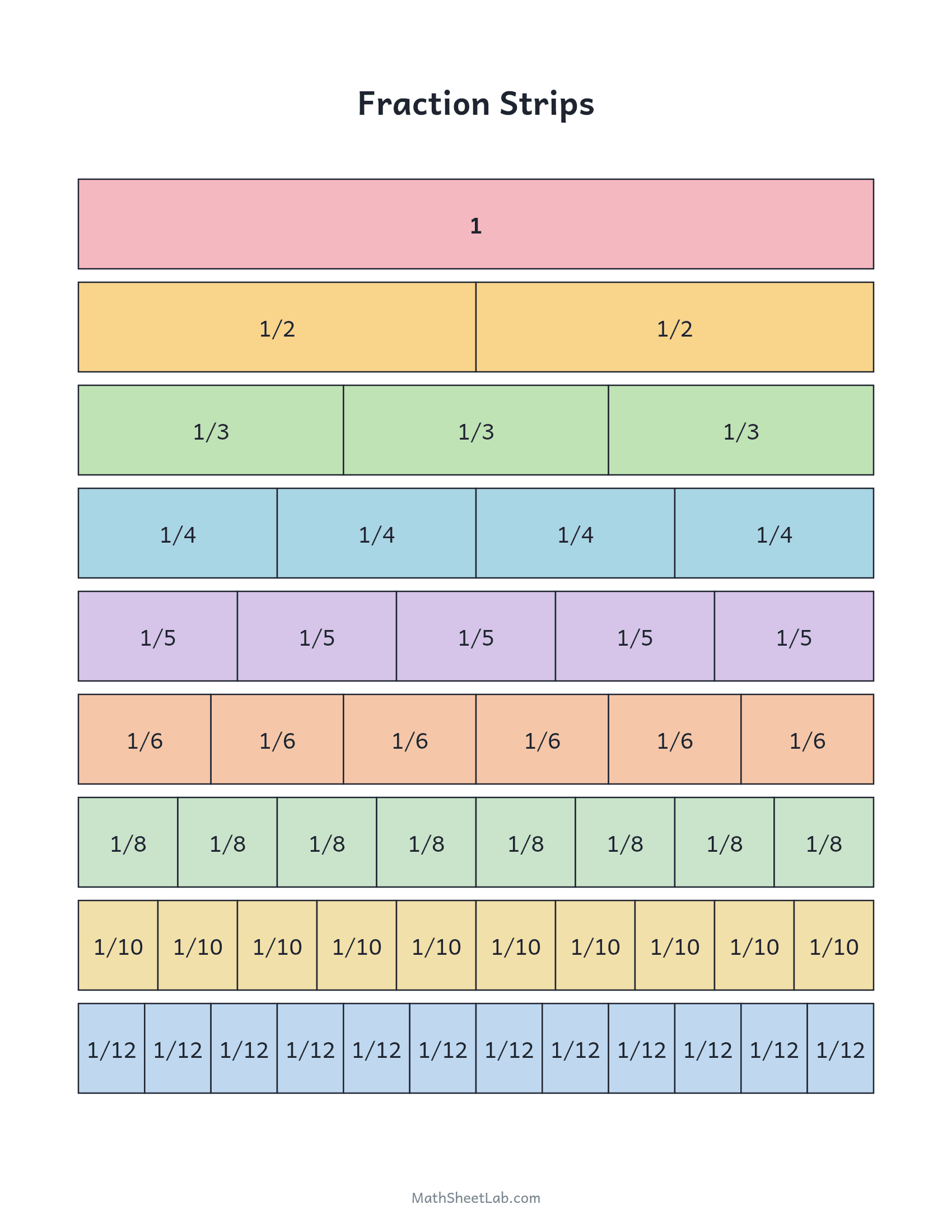
Color-coded fraction bars from one whole down to twelfths — print, cut, compare.
How to print it
- Open the print view. Press Print for a clean print-ready view, or download the PDF or PNG below the chart.
- Fit to page. In the print dialog choose “Fit to page” — the chart is laid out for US Letter and scales cleanly onto A4.
- Copy freely. Print or photocopy as many as you need for home, classroom or tutoring use. It is free, with no sign-up.
About the fraction strips
Fraction strips make fractions something a child can hold: every row is the same whole, cut into more (and therefore smaller) equal parts. Line up the halves row against the fourths row and the equivalence is plain to see: 1/2 sits exactly over 2/4. This set runs 1, 1/2, 1/3, 1/4, 1/5, 1/6, 1/8, 1/10 and 1/12, color-coded by row and labeled on every piece. Print on cardstock and cut the rows apart. For a chart that stays in one piece, with sevenths, ninths and elevenths and a decimal on every piece, use the fraction wall.
Grade level: this chart is used in our 3rd grade math worksheets and 5th grade math worksheets collections.
Frequently asked questions
How do you use fraction strips?
Cut the rows into pieces and compare: how many sixths cover a half? Which is bigger, 2/3 or 3/4? Physical comparison builds the intuition that rules alone don’t.
Why these denominators?
Halves through sixths plus eighths, tenths and twelfths cover the classic fraction-strip set, rich in equivalences (2/4 = 1/2, 4/8 = 1/2). Sevenths, ninths and elevenths share few edges with other rows, so they are left to the fraction wall.
Should I laminate them?
If you can — cardstock or lamination keeps cut pieces usable all year. On a black-and-white copier the colors all come out as the same pale gray, so the label on each piece is what tells the rows apart.