Fraction wall
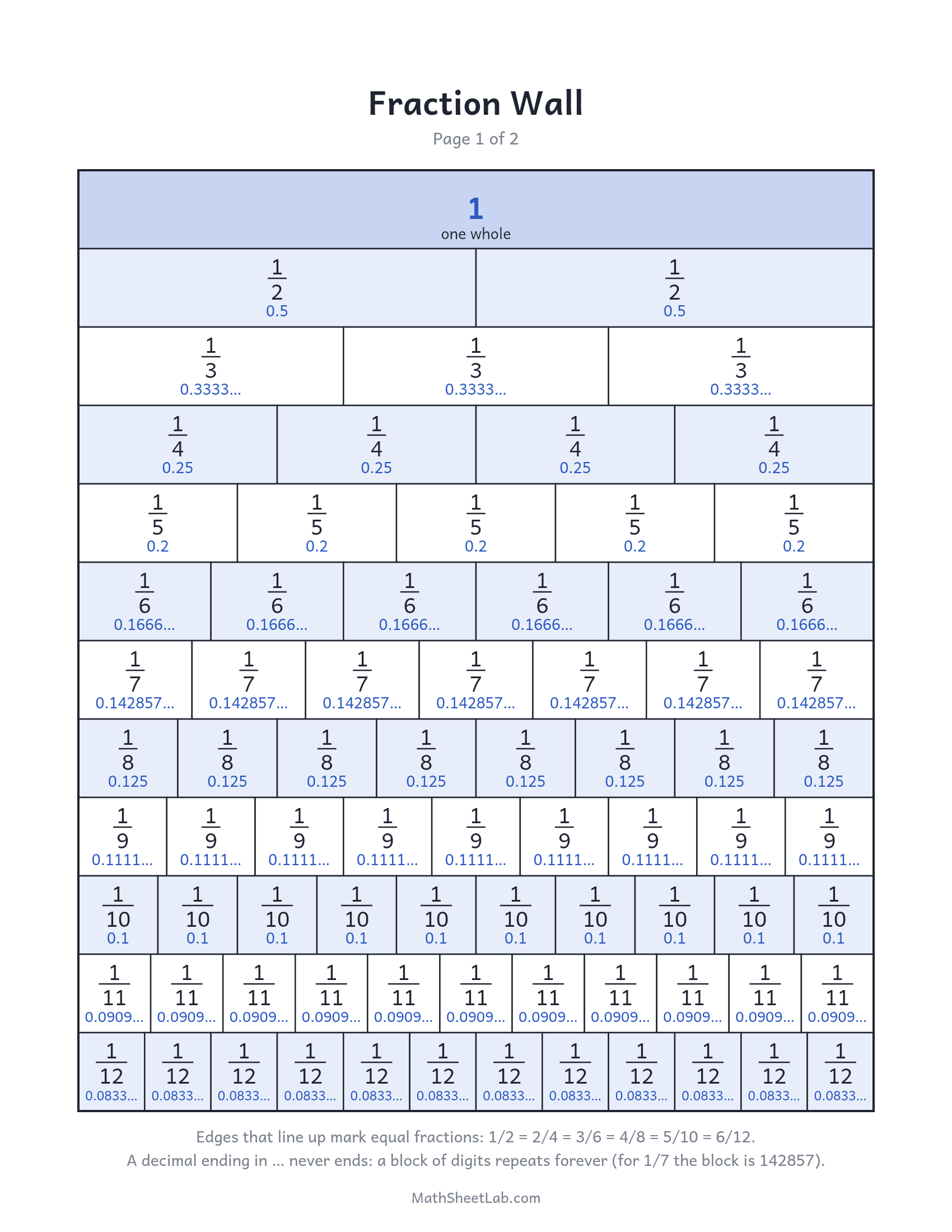
A fraction wall from one whole down to twelfths, with every piece labeled as a fraction and as a decimal. Page 2 lists the equivalent fractions in rows.
Both pages
Page 1 is the fraction wall for comparing sizes by eye; page 2 lists the halves, thirds, fourths, fifths, sixths, eighths, tenths and twelfths families as numbers, so a child can check what the wall shows.
-
Fraction wall
-
Equivalent fractions
How to print it
- Open the print view. Press Print for a clean print-ready view of page 1, or download it as a PDF or PNG. The other pages are in the gallery below, with a button to download them all.
- Fit to page. In the print dialog choose “Fit to page” — the chart is laid out for US Letter and scales cleanly onto A4.
- Copy freely. Print or photocopy as many as you need for home, classroom or tutoring use. It is free, with no sign-up.
About the fraction wall
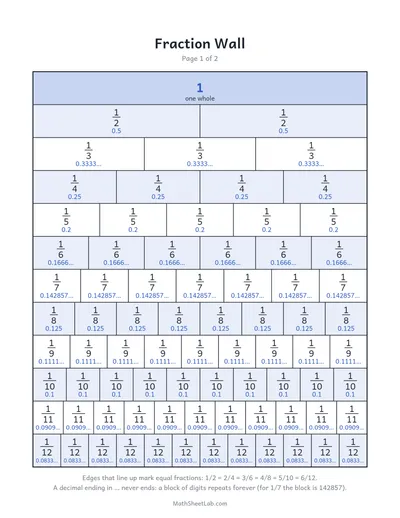
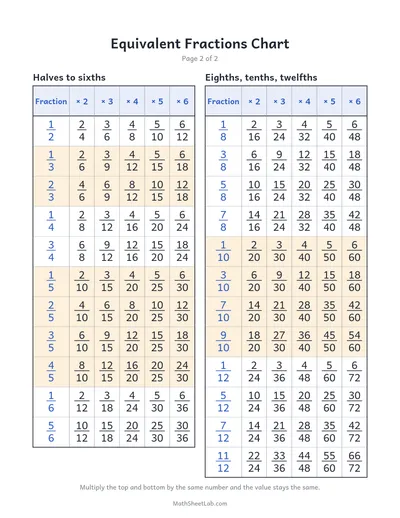
This fraction wall has twelve bars of the same length: the top bar is one whole and each bar below is cut into one more equal piece, down to twelfths. Every piece shows its fraction and its decimal, so 1/3 reads 0.3333… and 1/4 reads 0.25. Because the bars match, edges that line up mark equal fractions. Lay a ruler down the middle and it meets an edge after two fourths, three sixths, four eighths, five tenths and six twelfths. Sevenths and elevenths share no inside edge with any other row. Page 2 does the same with numbers for halves, thirds, fourths, fifths, sixths, eighths, tenths and twelfths: each row starts with a fraction in lowest terms and multiplies its top and bottom by 2, 3, 4, 5 and 6.
Grade level: this chart is used in our 3rd grade math worksheets and 4th grade math worksheets collections.
Frequently asked questions
Is a fraction wall the same as fraction strips?
Same idea, different job. Fraction strips are cut apart and handled; a wall keeps every row in place so sizes can be compared by eye. This wall also includes sevenths, ninths and elevenths and prints a decimal on every piece.
How do you find equivalent fractions on the chart?
Pick the right edge of a piece and look straight down. Every edge that lines up with it is an equal fraction: the end of 1/3 lines up with 2/6, 3/9 and 4/12. Page 2 gives the same answers as numbers.
Why do some decimals end in …?
Some fractions never finish as decimals. One third is 0.3333… with the 3s going on forever, and the … means the pattern keeps going. The wall shows four decimal places for these, except 1/7, which needs six to show its whole repeating block: 0.142857…
Which is bigger, 2/3 or 3/4?
Count two thirds along the thirds row and three fourths along the fourths row. Three fourths reaches further, so it is bigger, and the decimals agree: 0.6666… is less than 0.75.