120 chart
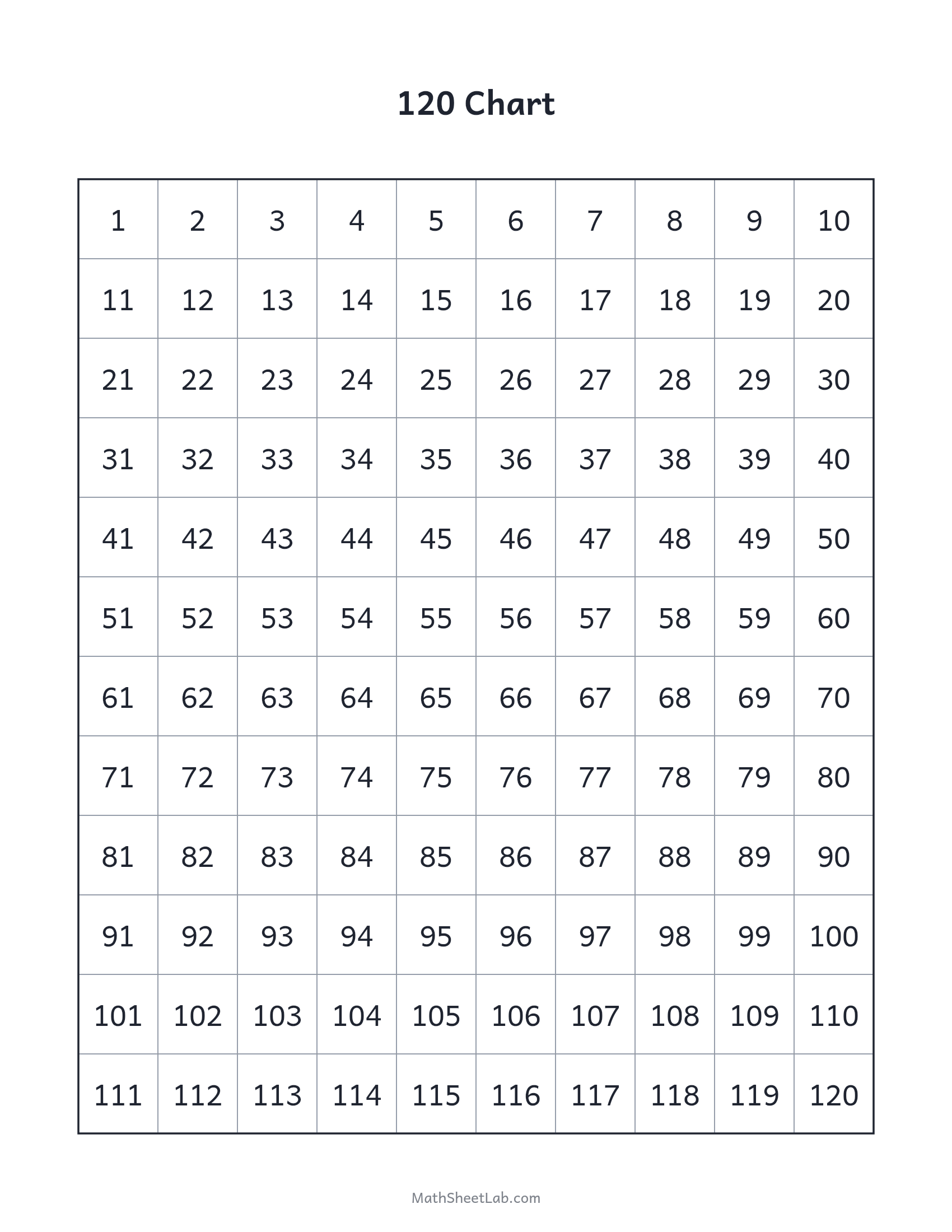
The hundreds chart, extended to 120 — because first grade doesn’t stop at 100.
How to print it
- Open the print view. Press Print for a clean print-ready view, or download the PDF or PNG below the chart.
- Fit to page. In the print dialog choose “Fit to page” — the chart is laid out for US Letter and scales cleanly onto A4.
- Copy freely. Print or photocopy as many as you need for home, classroom or tutoring use. It is free, with no sign-up.
About the 120 chart
US 1st-grade standards expect counting to 120, not 100, and crossing 100 is where many children slip ("…108, 109, two hundred?"). A 120 chart adds two rows to the hundreds chart, with the same ten-wide layout and the same patterns, so the count carries on past 100 in plain view. Use it like a hundreds chart (counting, skip counting, ten more and ten less) with the 100–120 stretch included.
Grade level: this chart is used in our 1st grade math worksheets collection.
Frequently asked questions
Why 120 instead of 100?
First-grade standards include counting and reading numerals to 120, and the 100→101 transition is a known stumbling point. The extra rows give that exact practice.
Is the layout the same as a hundreds chart?
Yes — ten numbers per row. It simply continues for two more rows, ending at 120.
What activities work with it?
Everything a hundreds chart does: number hunts, skip-count coloring, one-more/ten-more moves, and fill-in-the-missing-number games across the 100 boundary.