Square root chart 1–100 (plus 101–200)
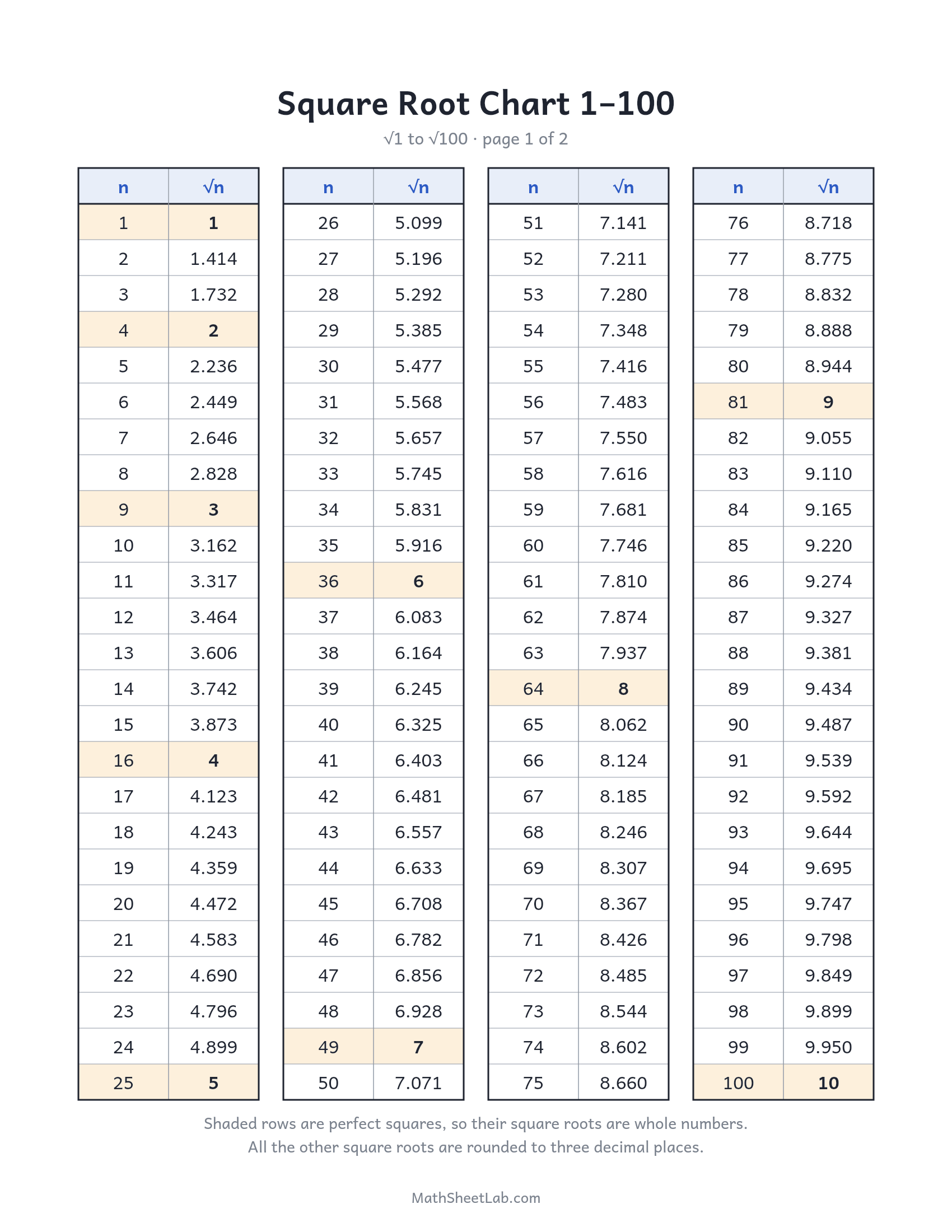
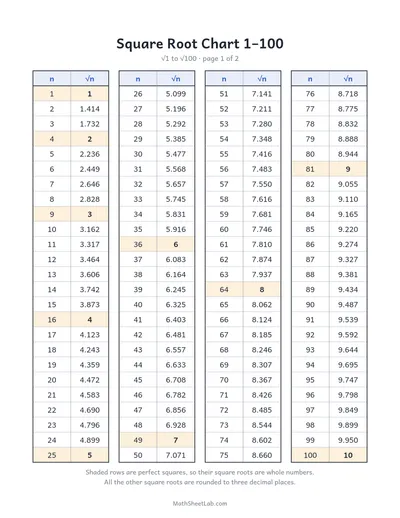
The square roots of 1 to 100 to three decimal places, with the 10 perfect squares shaded. Page 2 continues from 101 to 200.
Both pages
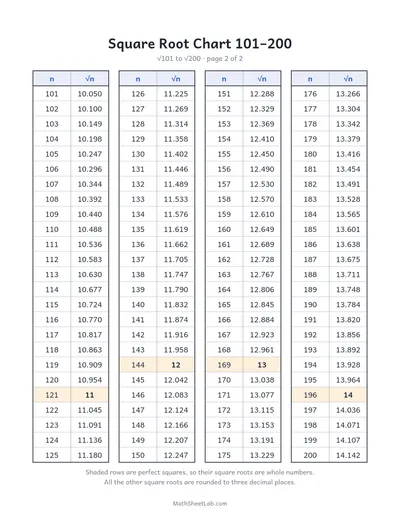
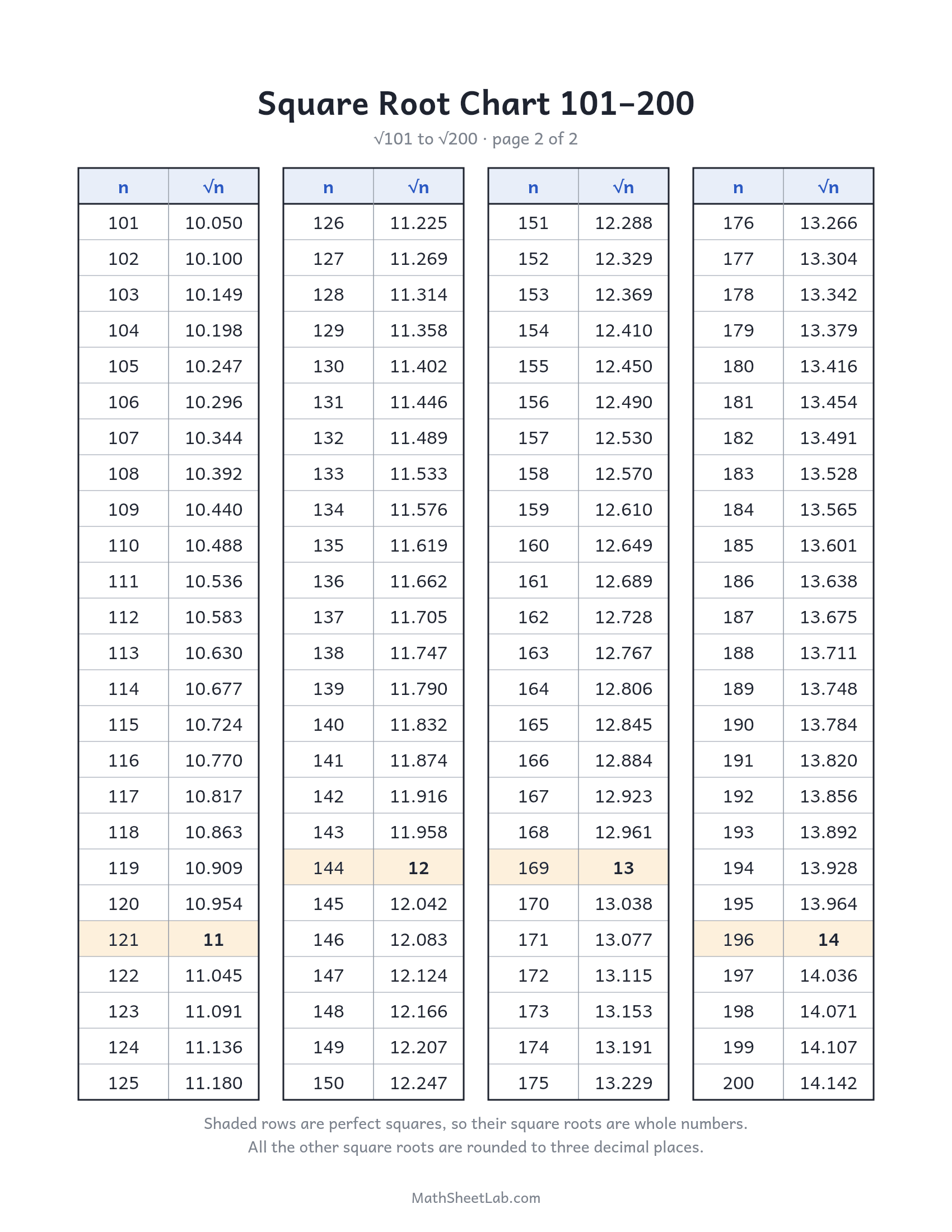
Page 1 is the standard 1 to 100 chart. Page 2 continues the same layout from 101 to 200 for students who need larger roots.
-
√1 to √100
-
√101 to √200
How to print it
- Open the print view. Press Print for a clean print-ready view of page 1, or download it as a PDF or PNG. The other pages are in the gallery below, with a button to download them all.
- Fit to page. In the print dialog choose “Fit to page” — the chart is laid out for US Letter and scales cleanly onto A4.
- Copy freely. Print or photocopy as many as you need for home, classroom or tutoring use. It is free, with no sign-up.
About the square root chart 1–100
A square root chart lets a student check or estimate a root without a calculator. The shaded rows are the perfect squares, the only numbers here with whole-number roots; all the others are endless decimals, rounded to three places. The rows between two shaded ones show how estimation works: √50 is 7.071, just past 7, because 50 is just past 49. The gaps between perfect squares also grow by two each time (3, 5, 7, 9 and so on), so the roots climb more slowly further down the chart. Page 2 runs from 101 to 200, which covers many Pythagorean theorem answers, such as √125 ≈ 11.180.
Frequently asked questions
Which numbers have whole-number square roots?
Only perfect squares. From 1 to 100 there are 10 of them (1, 4, 9 up to 100), and 101 to 200 adds 4 more: 121, 144, 169 and 196.
How accurate are the values?
Each root is rounded to three decimal places, so the printed value is within 0.0005 of the true root. √2 is 1.41421356… and prints as 1.414.
How do you estimate a square root without the chart?
Find the perfect squares either side. 60 lies between 49 and 64, so √60 is between 7 and 8, and nearer 8 because 60 is closer to 64. The chart gives 7.746.
What grade learns square roots?
Square root symbols and the Pythagorean theorem are 8th-grade topics in Common Core states. Younger students meet perfect squares earlier, on the multiplication chart diagonal and in area problems.