Addition flash cards (sums to 20)
All 100 addition facts from 1 + 1 to 10 + 10 as cut-out cards, one sheet for each number being added, with the sums on a sheet that prints on the back.
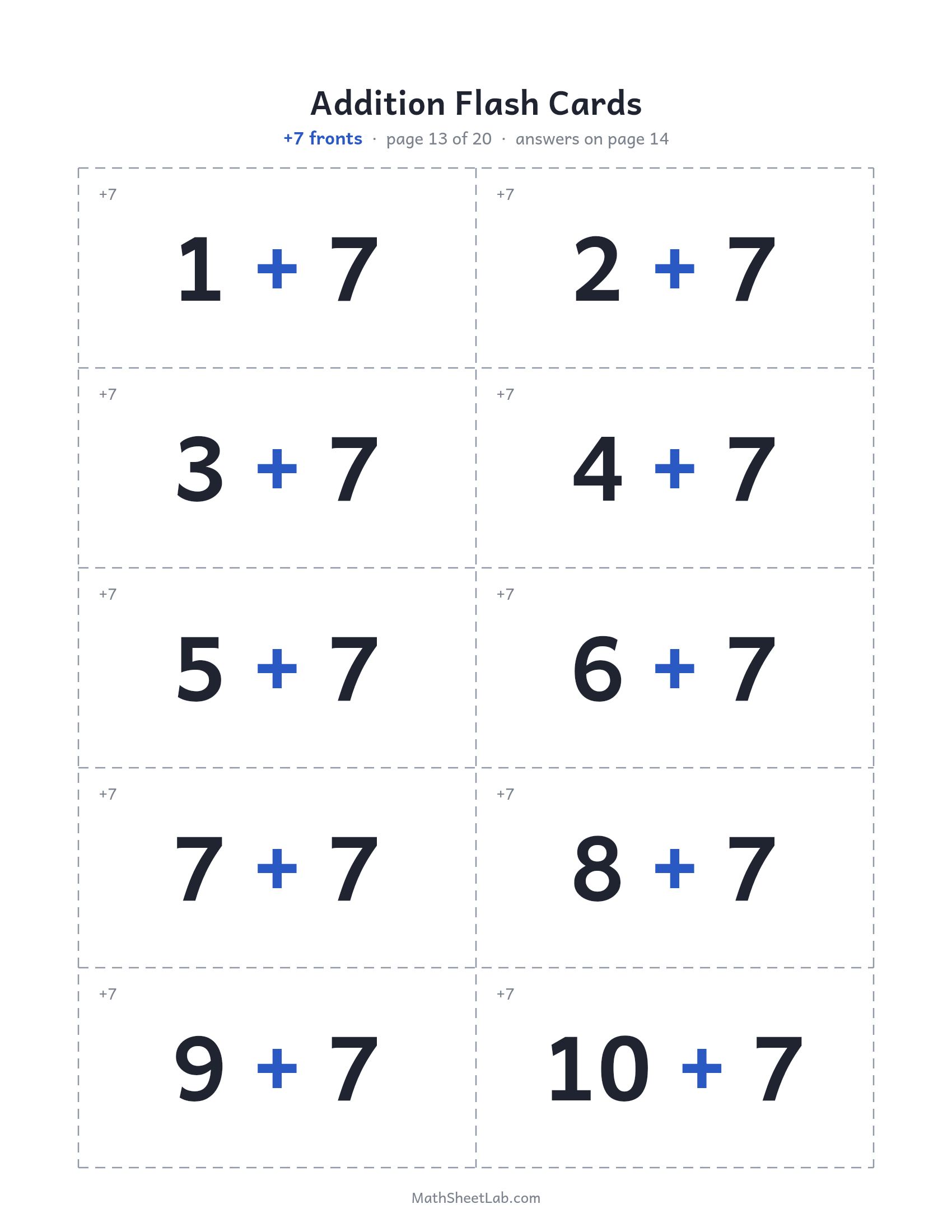
All 20 pages: +1 to +10, facts and answers
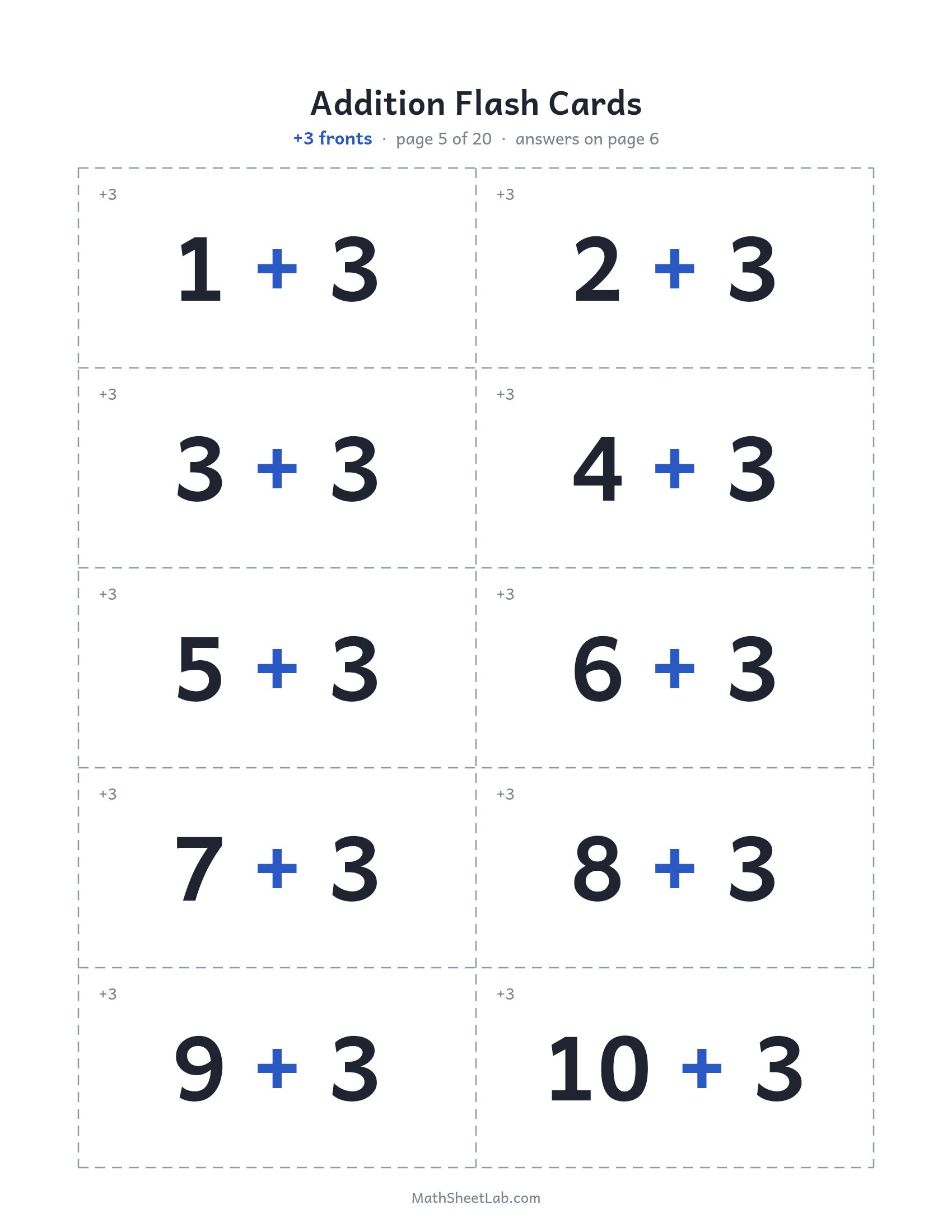
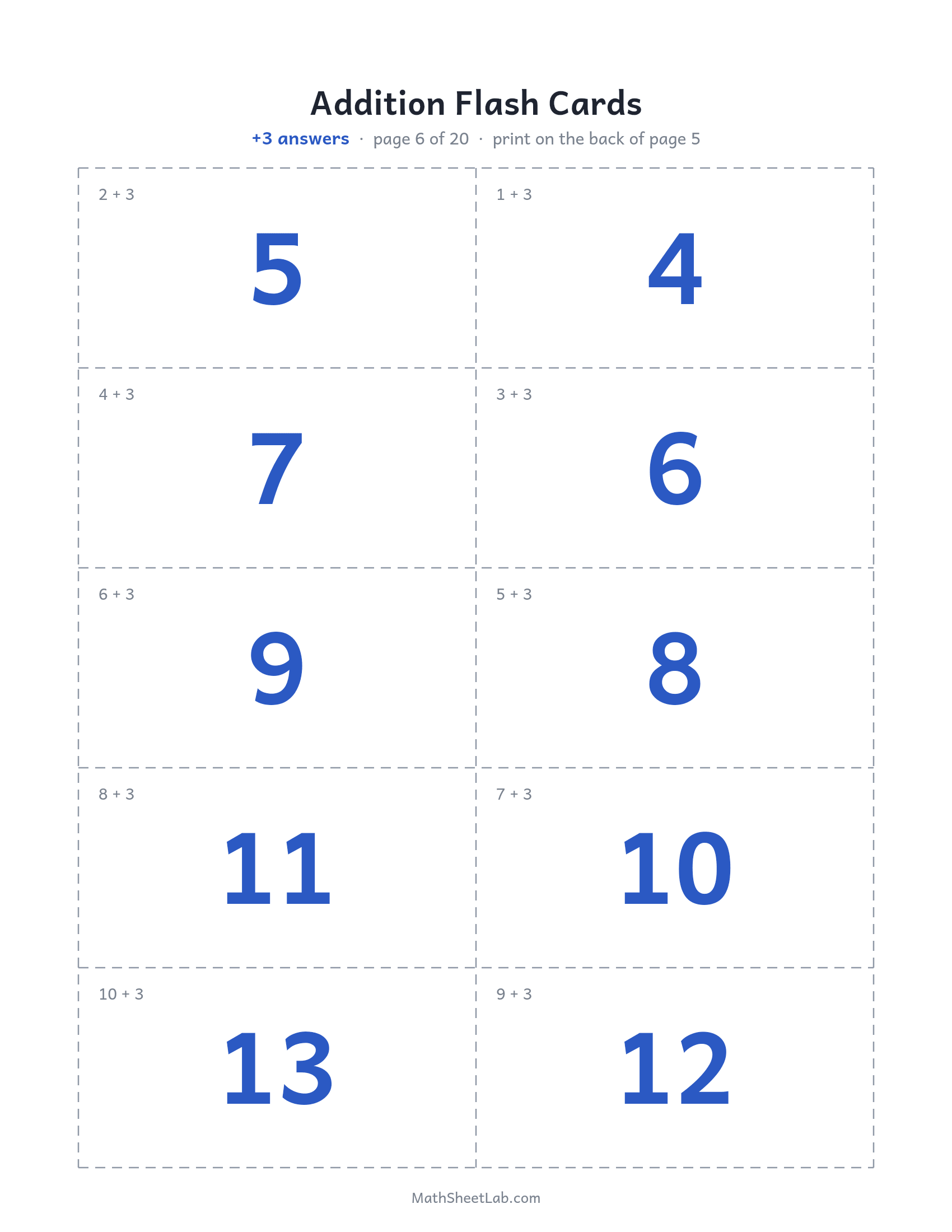
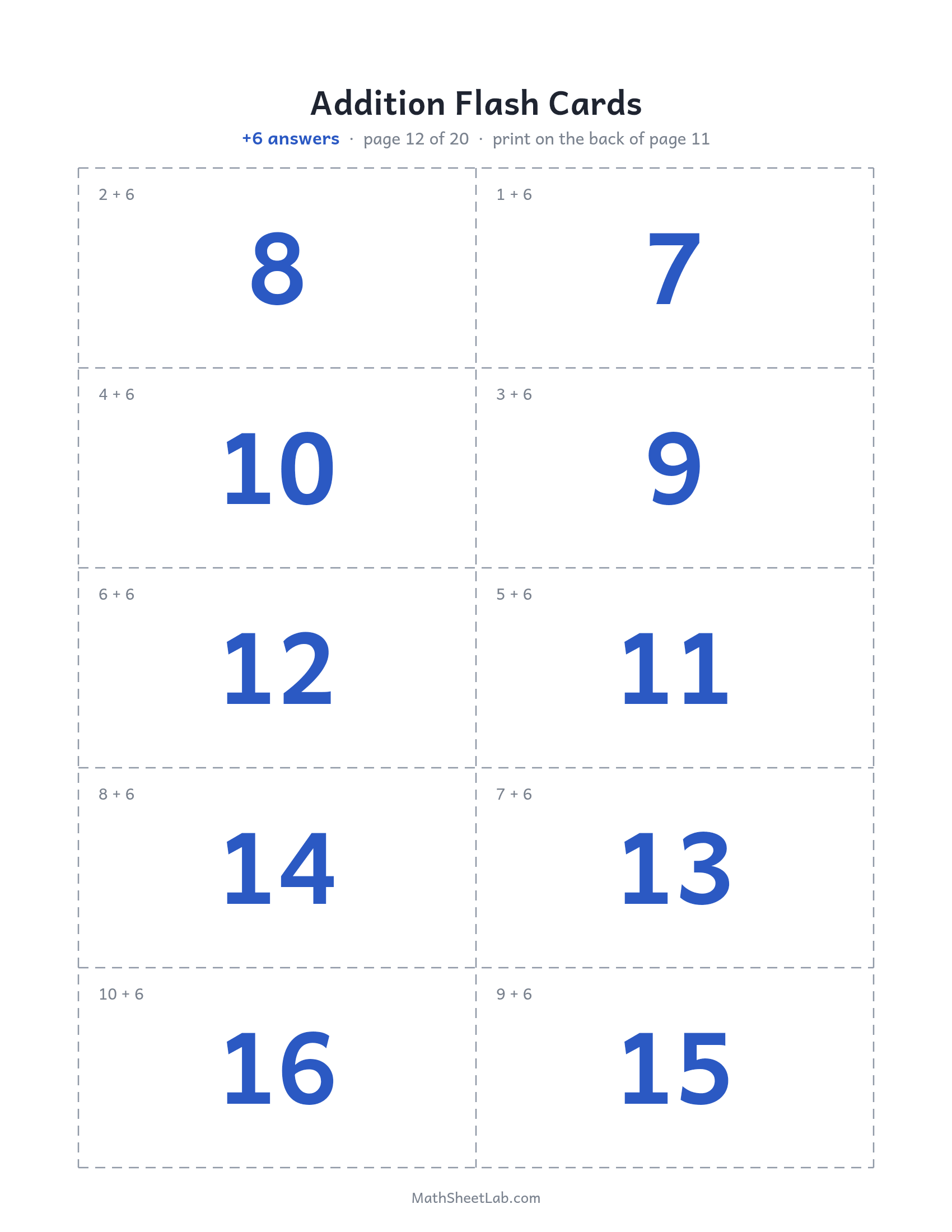
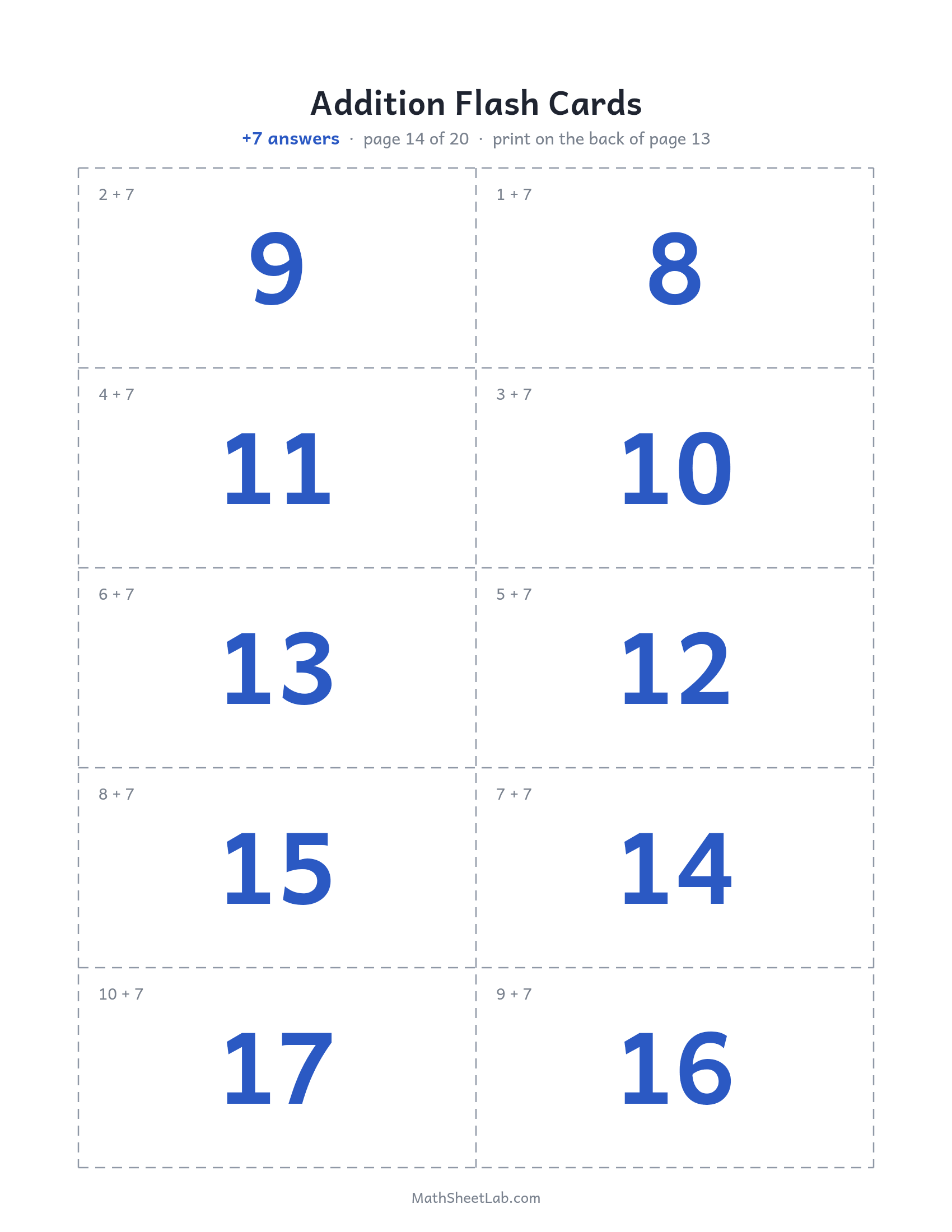
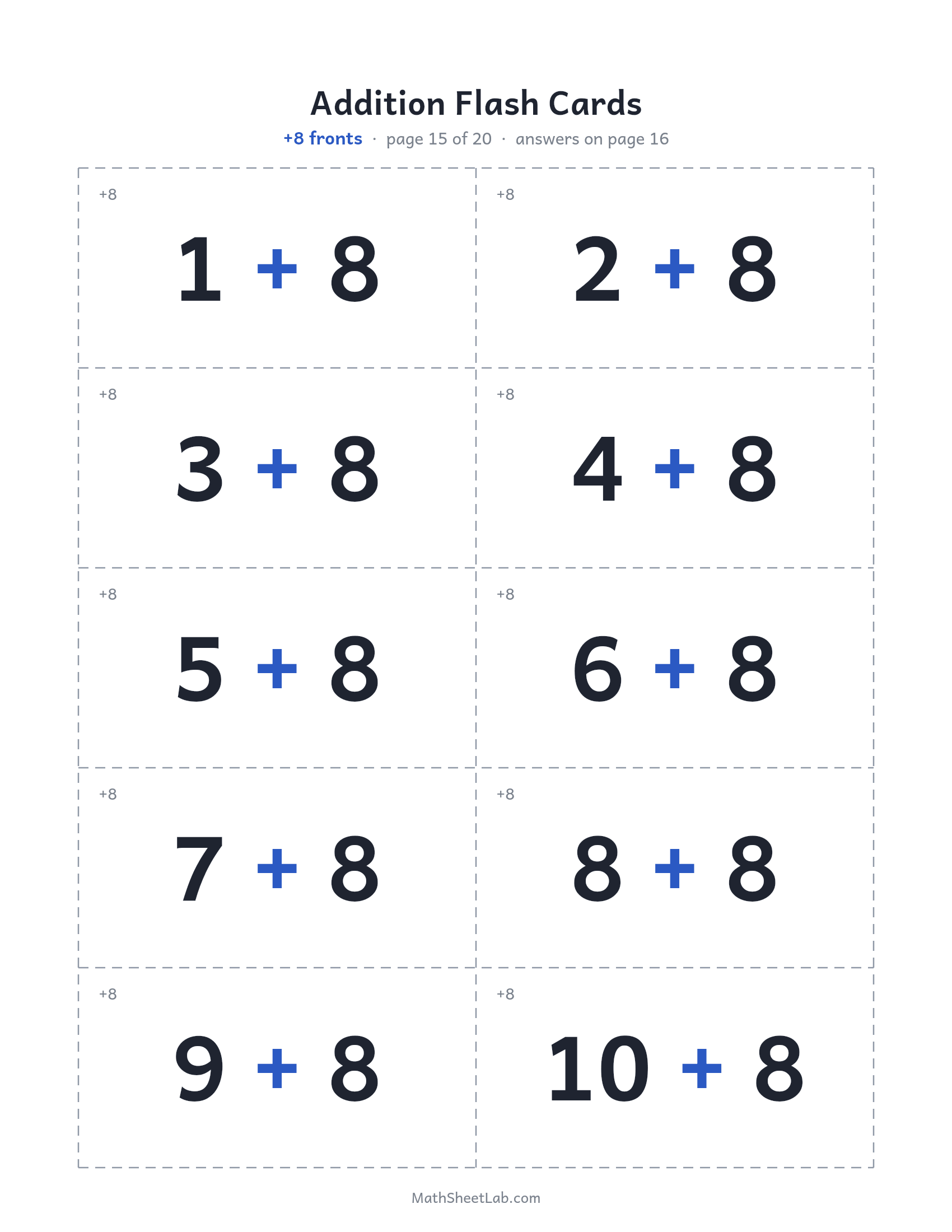
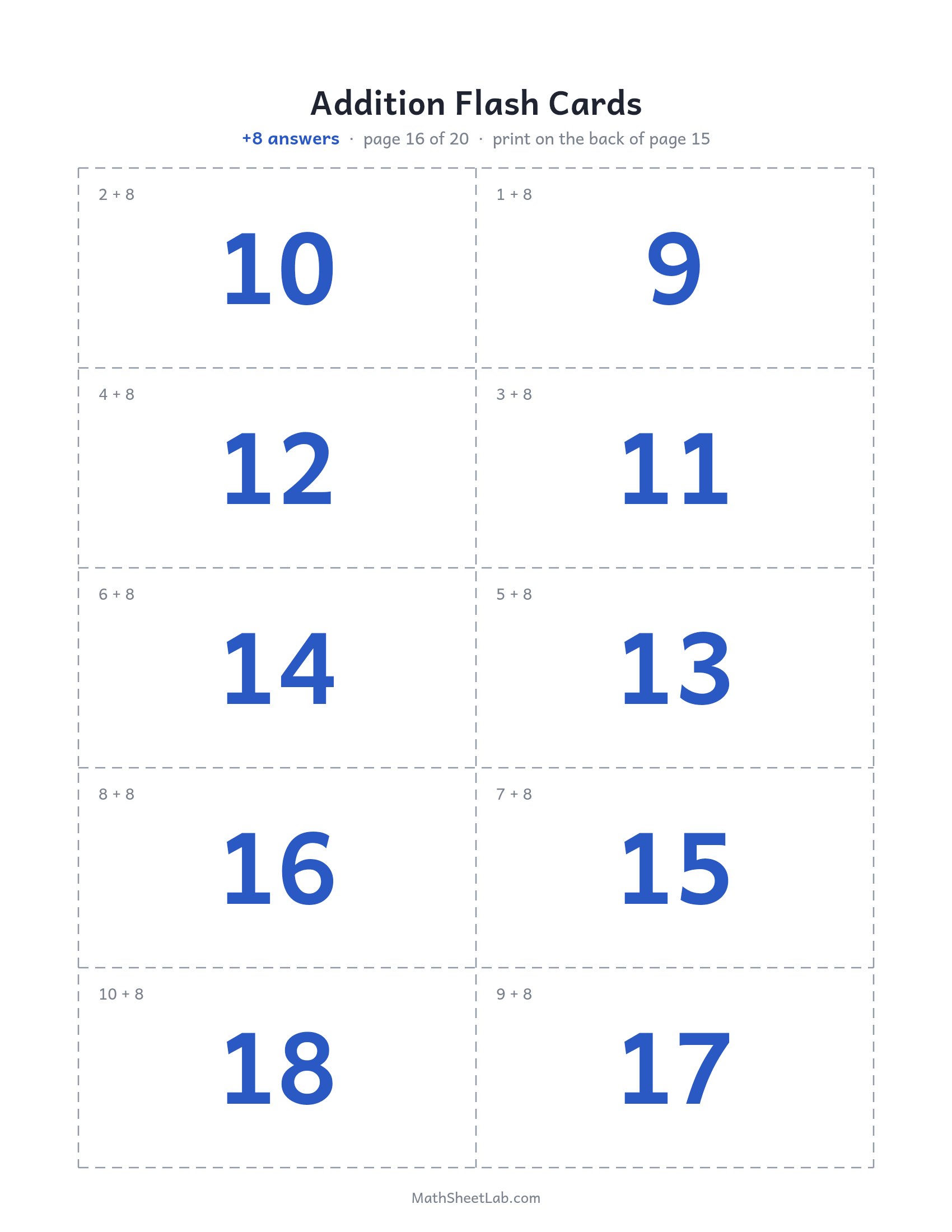
Pages come in pairs, ten facts and then their sums, so the full PDF prints double-sided in the right order. Each pair covers one number being added; to redo one, print its two pages from the full PDF (the +3 cards are pages 5 and 6).
-
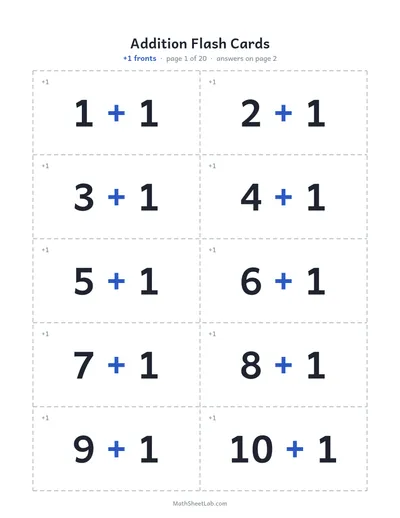
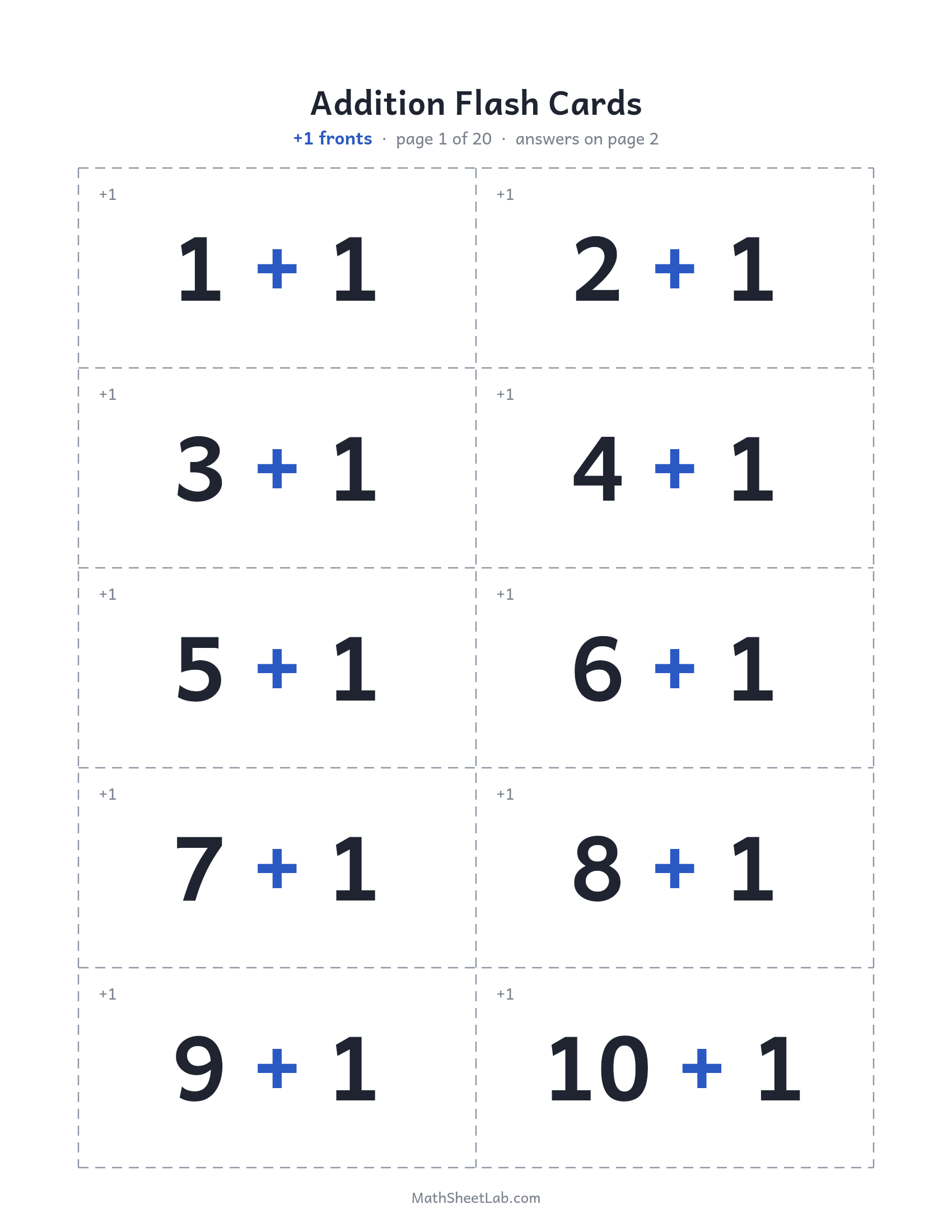
+1 fronts
-
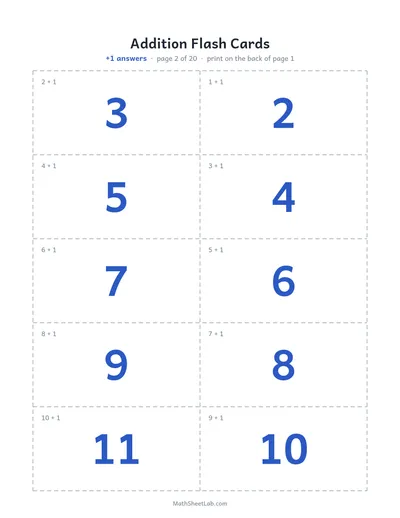
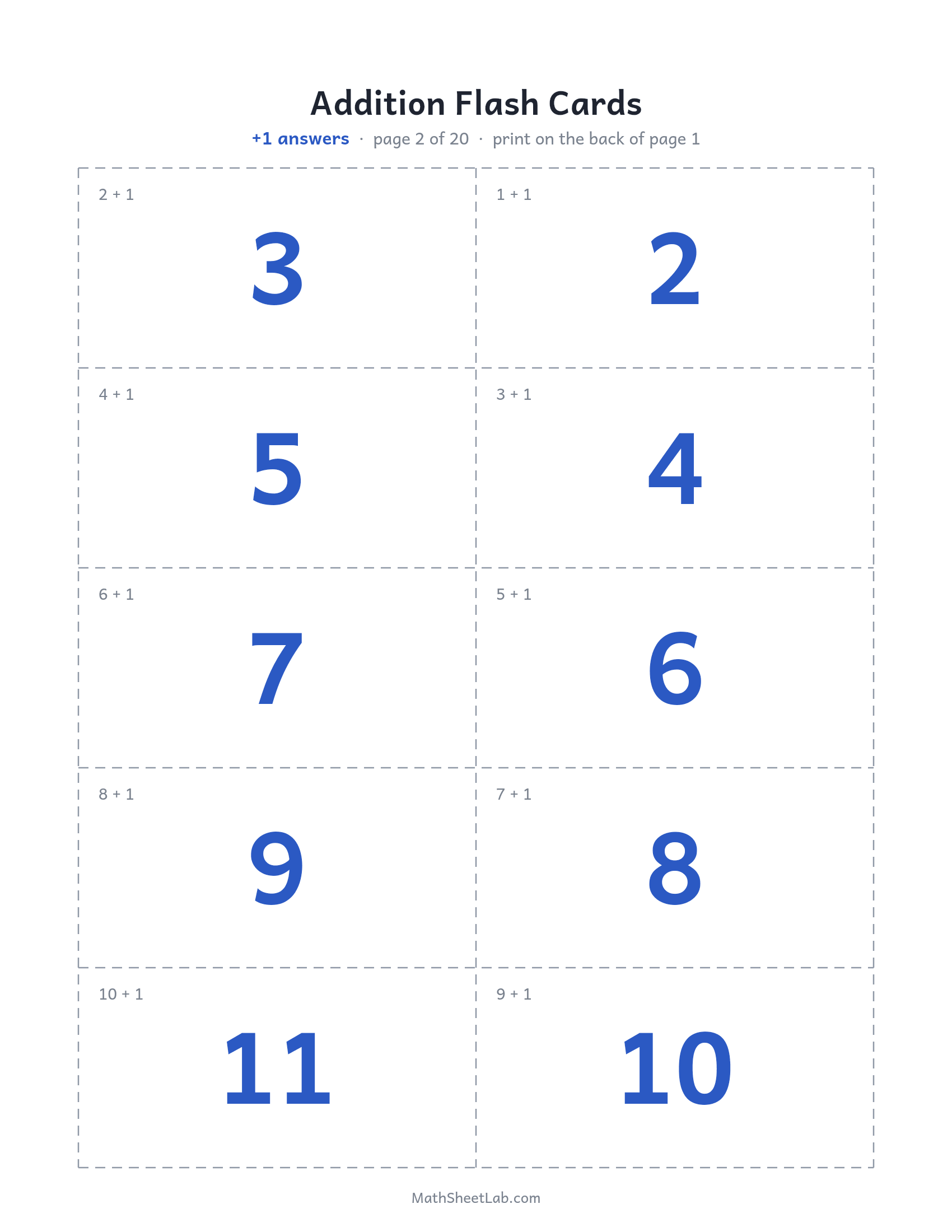
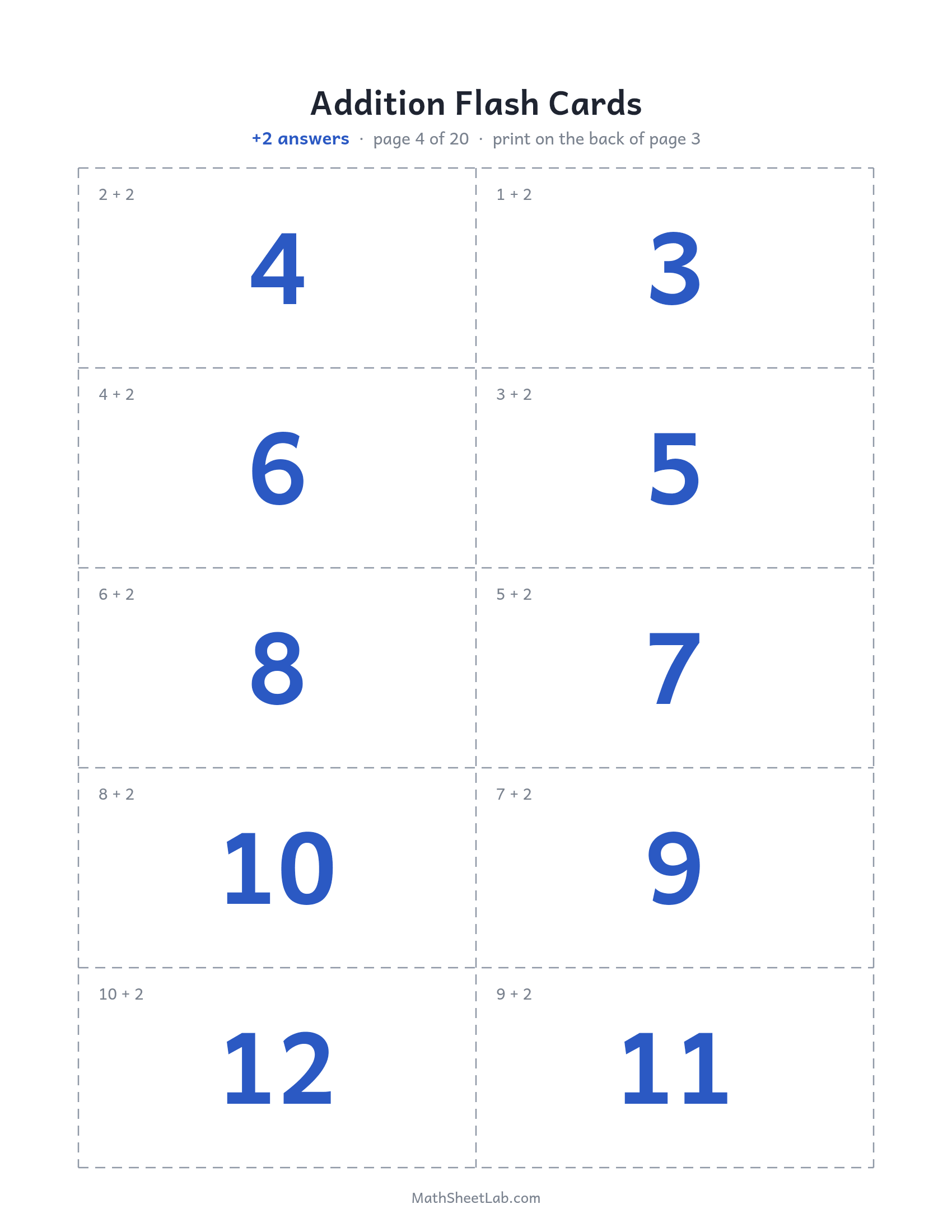
+1 answers
-
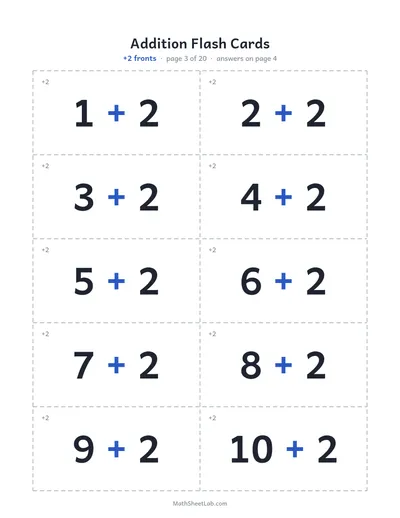
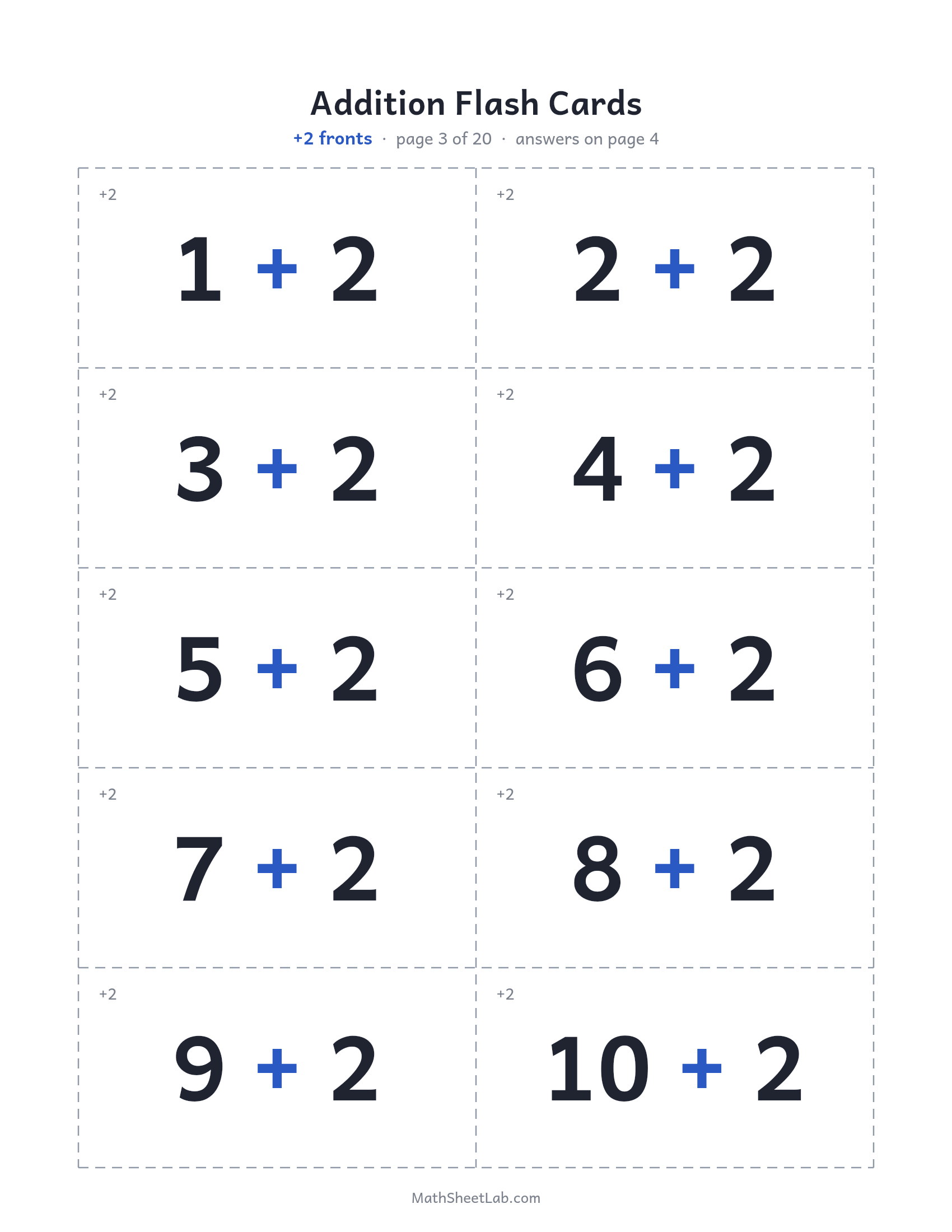
+2 fronts
-
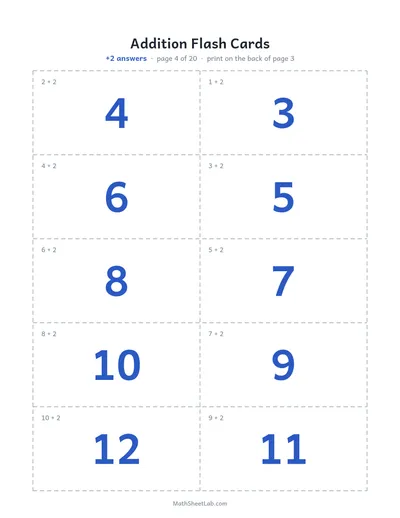
+2 answers
-
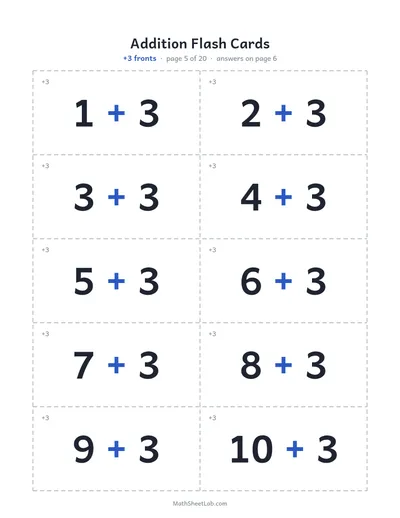
+3 fronts
-
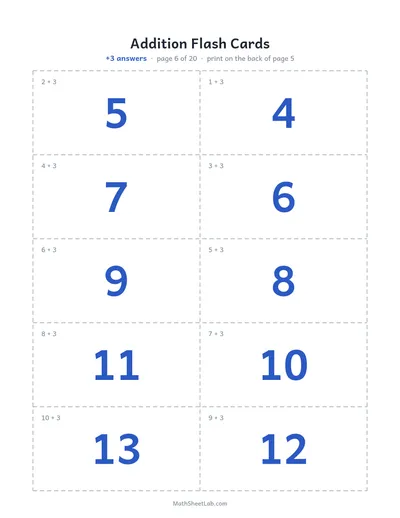
+3 answers
-
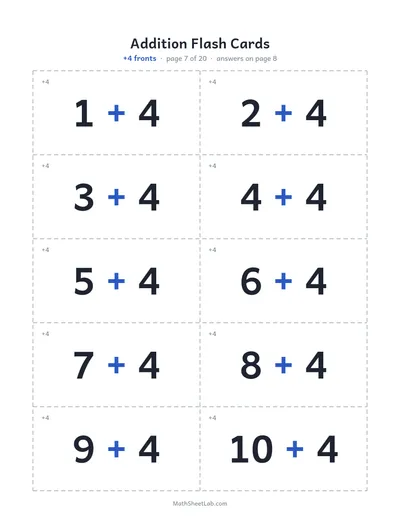
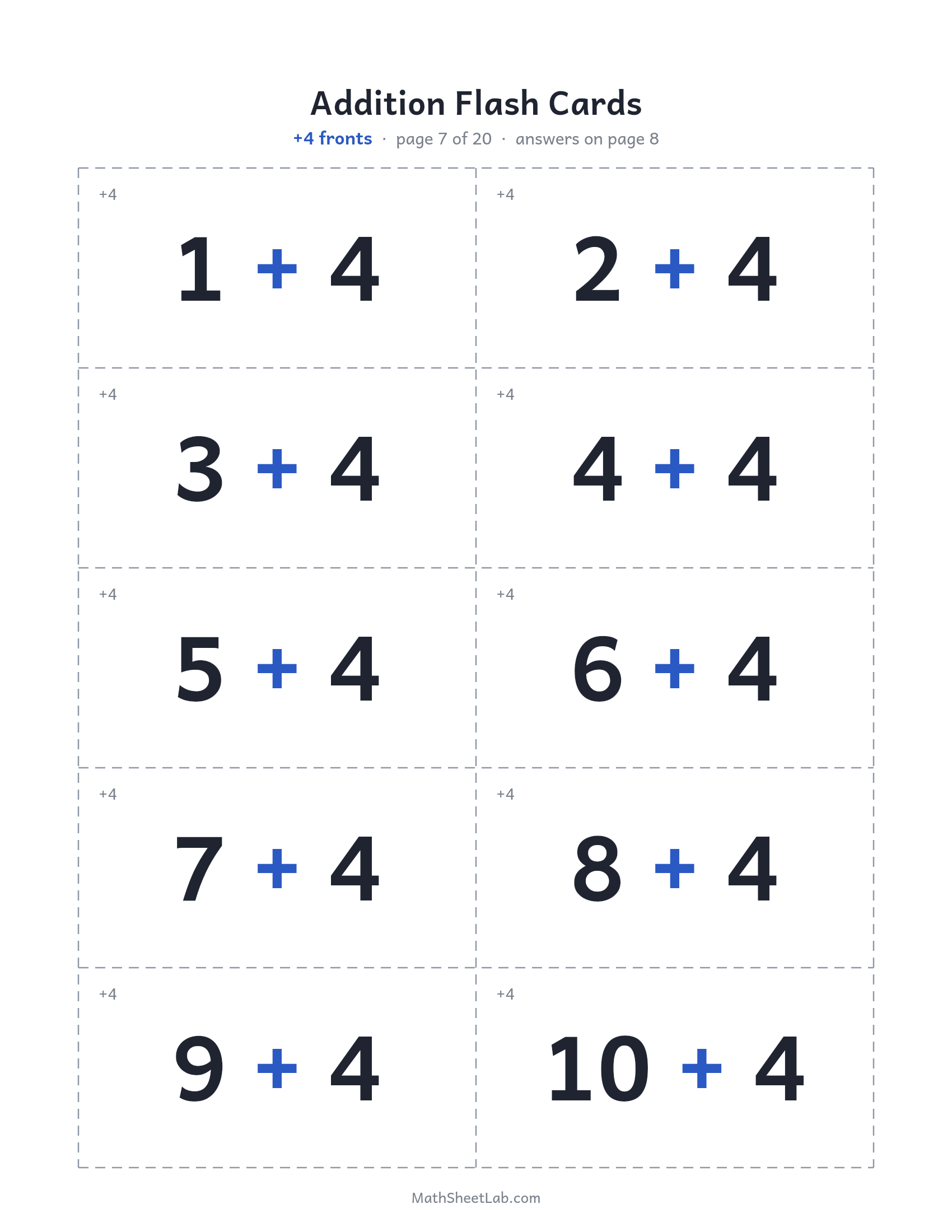
+4 fronts
-
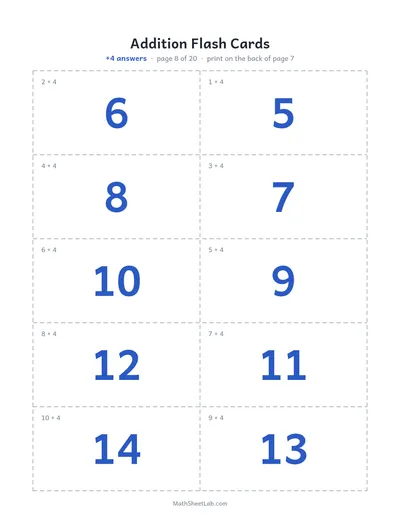
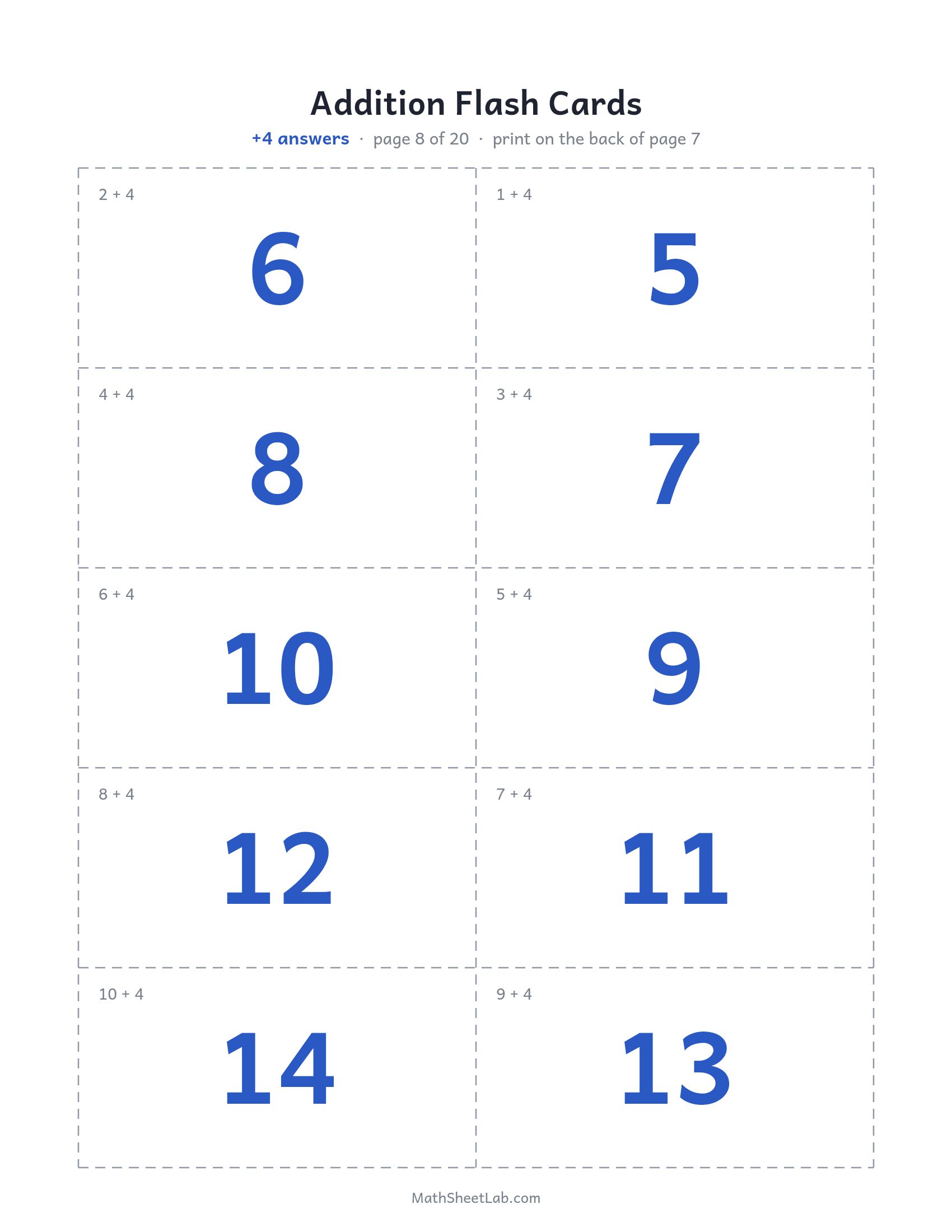
+4 answers
-
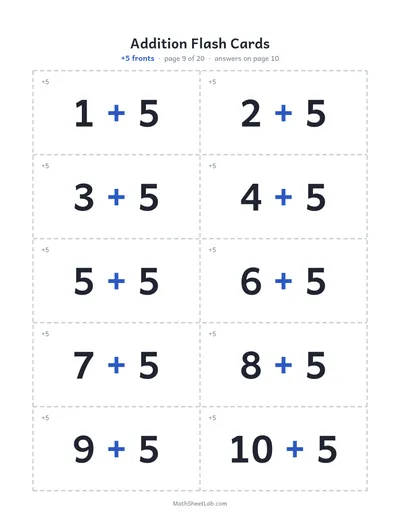
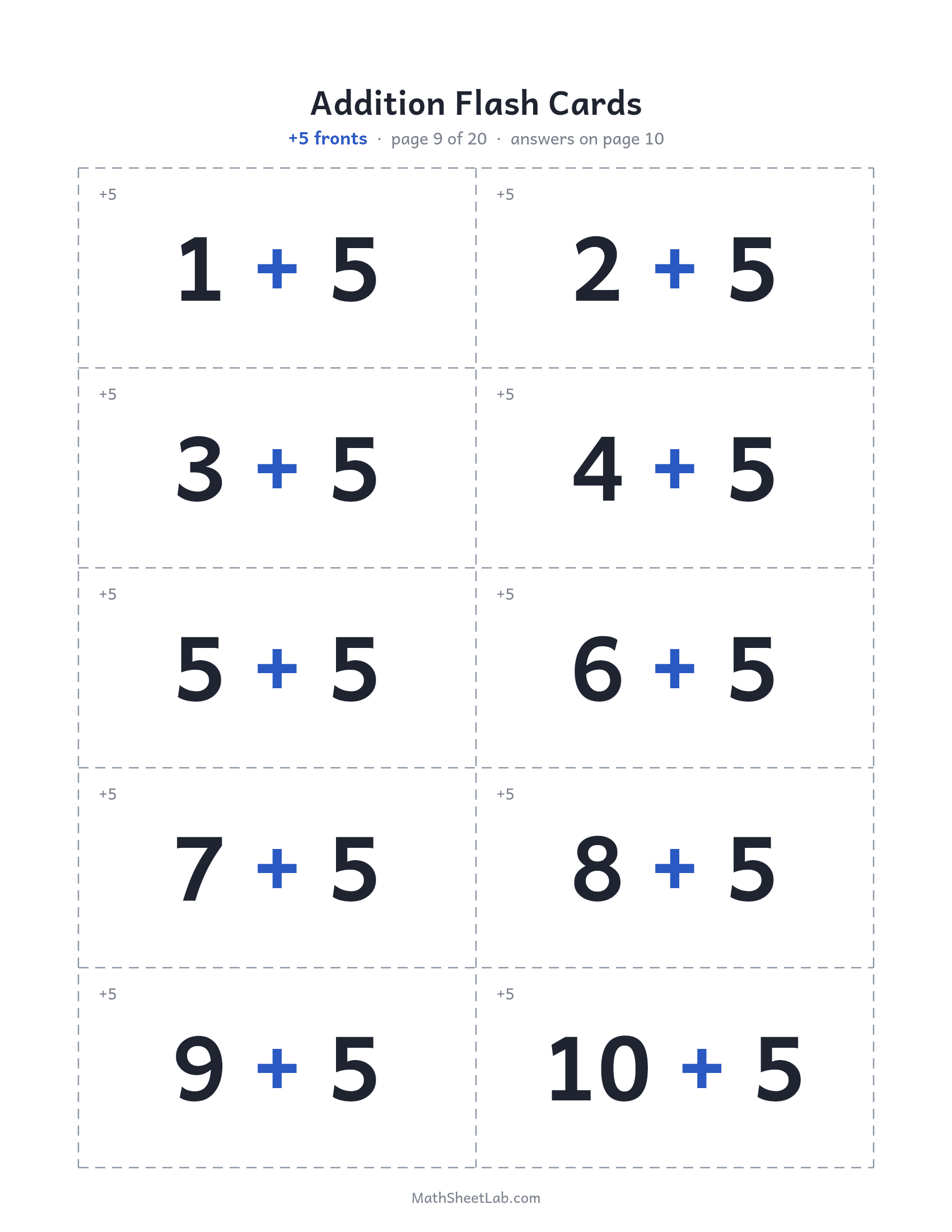
+5 fronts
-
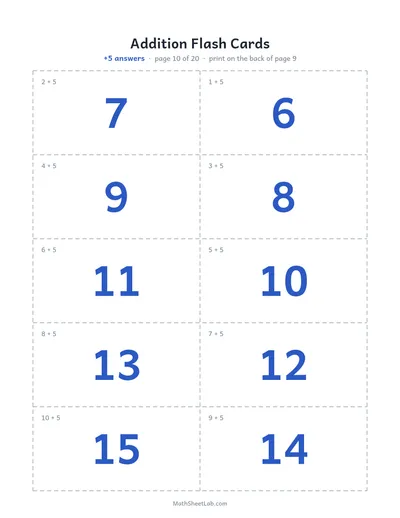
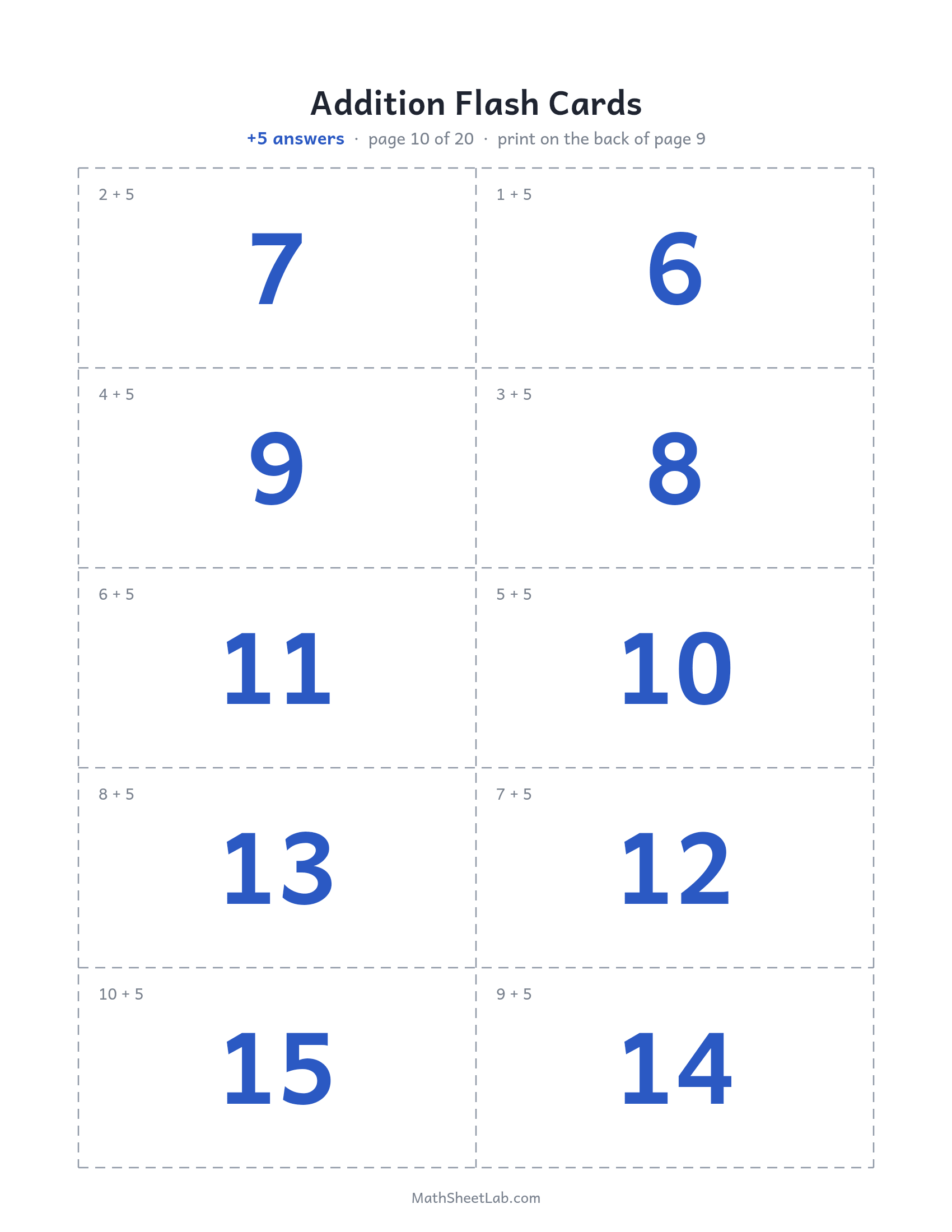
+5 answers
-
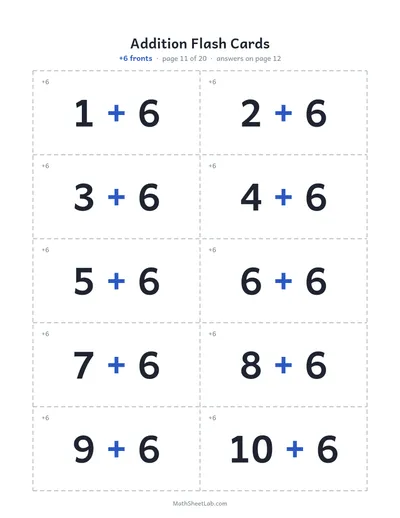
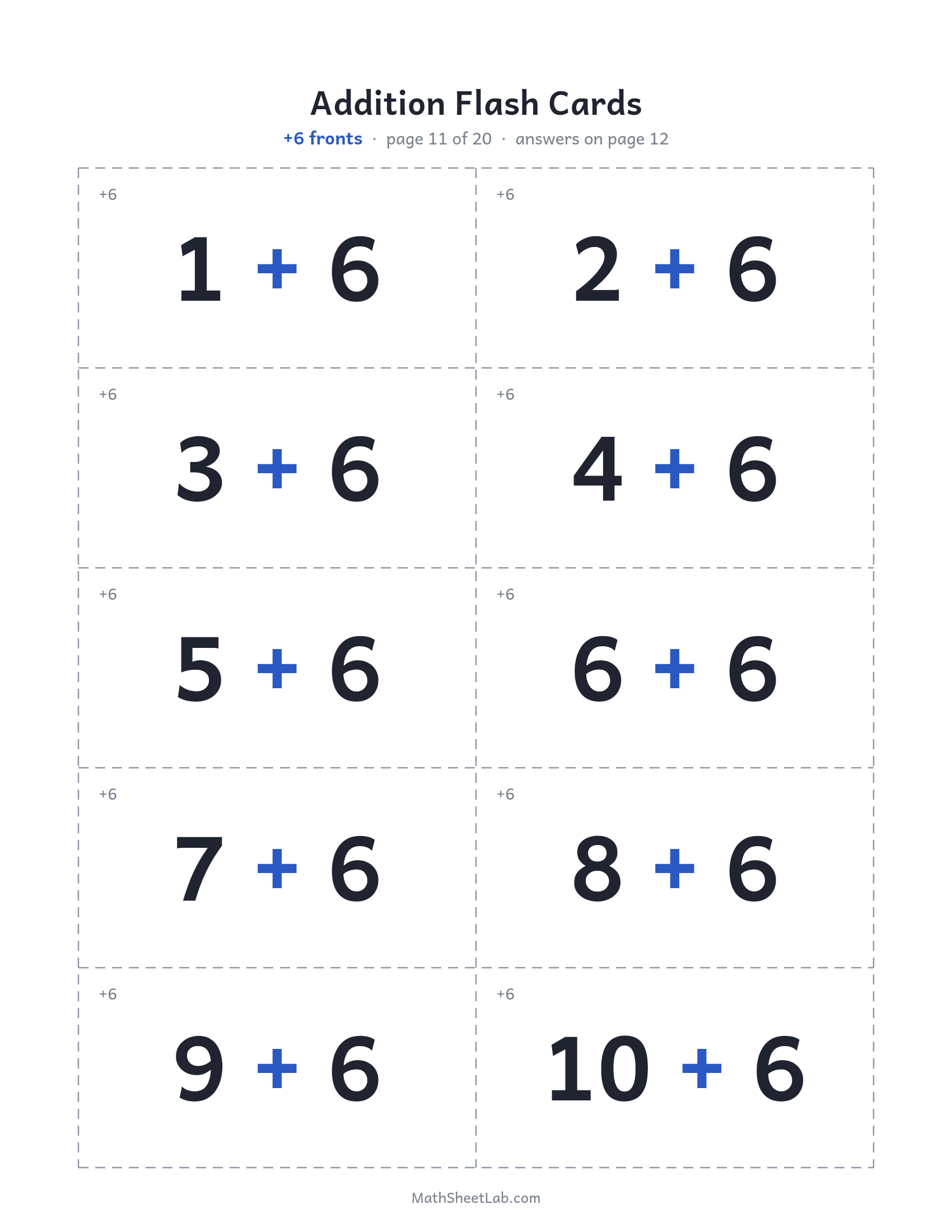
+6 fronts
-
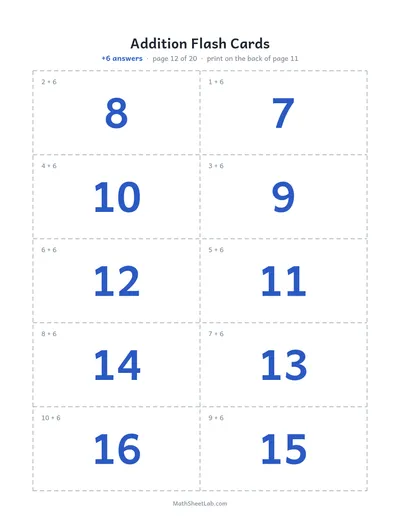
+6 answers
-
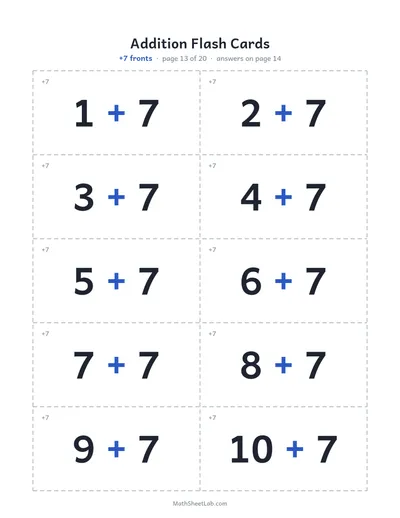
+7 fronts
-
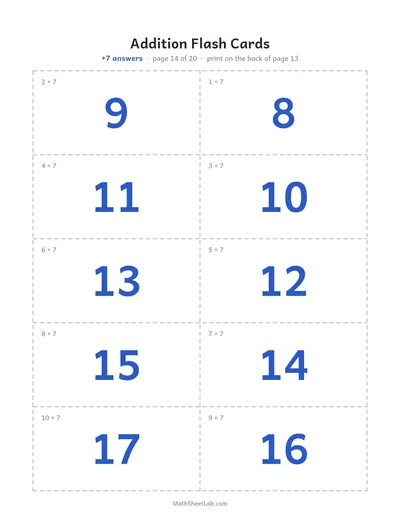
+7 answers
-
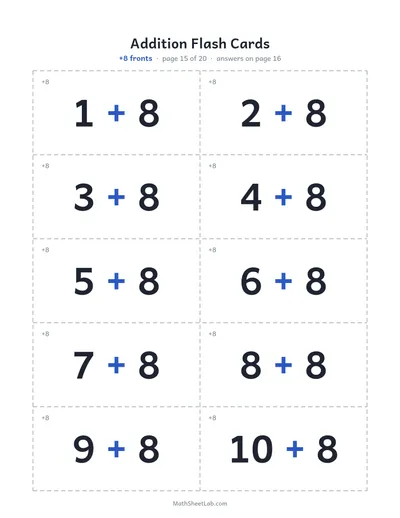
+8 fronts
-
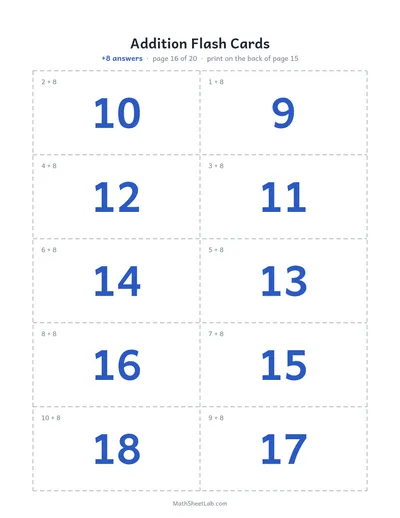
+8 answers
-
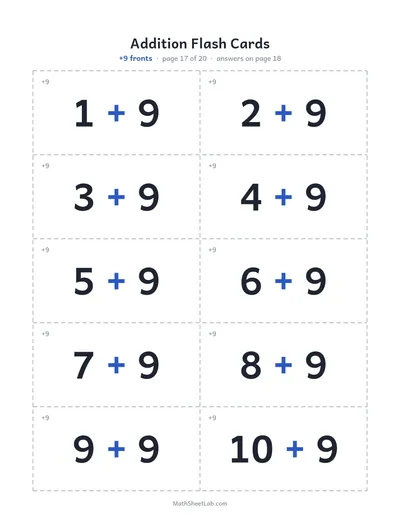
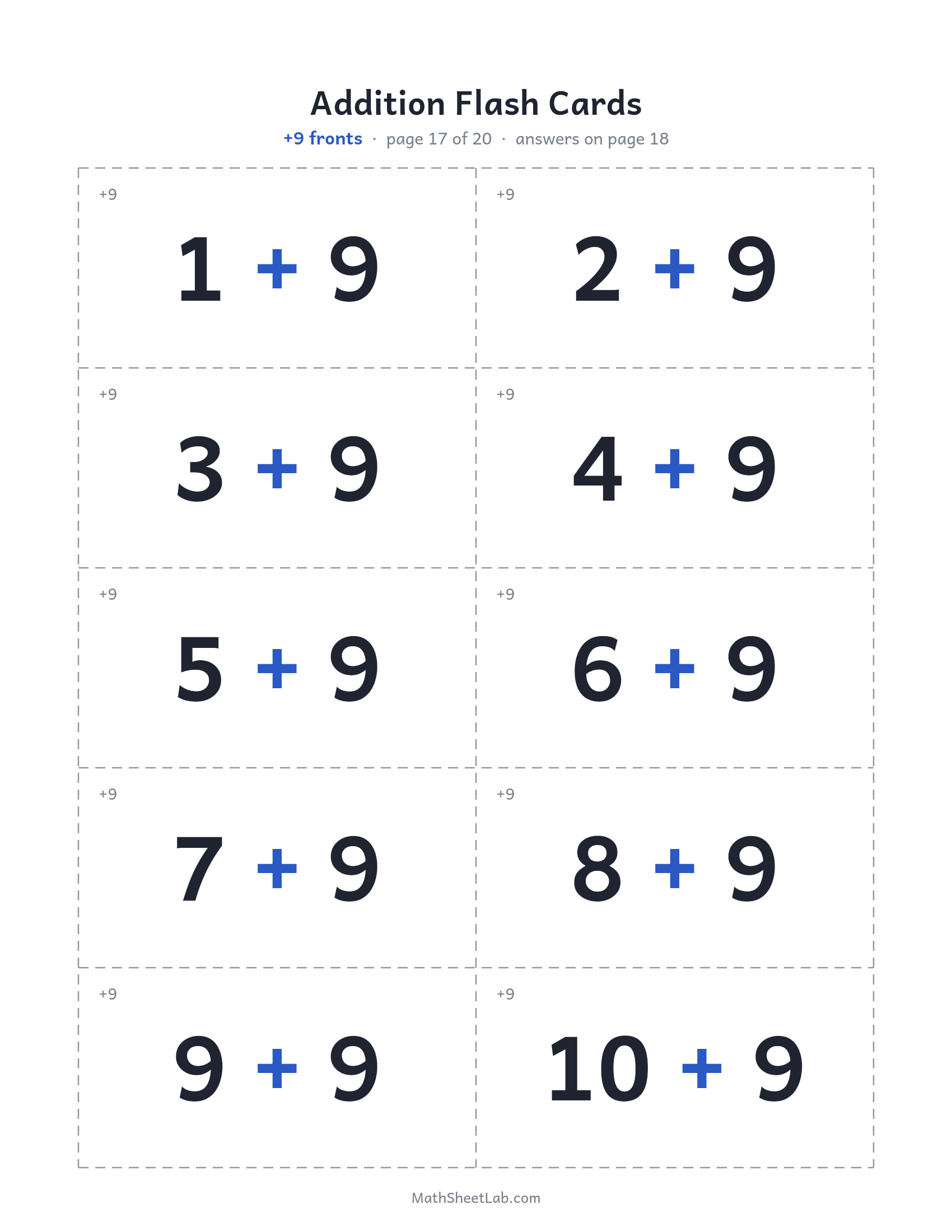
+9 fronts
-
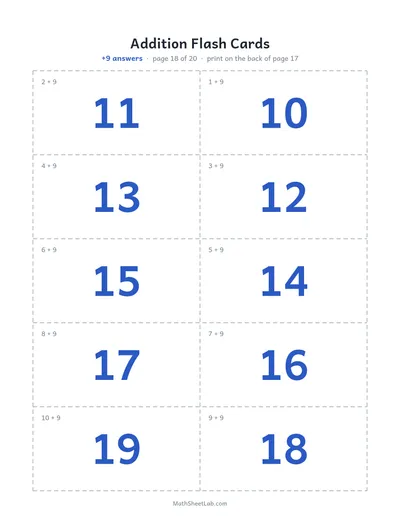
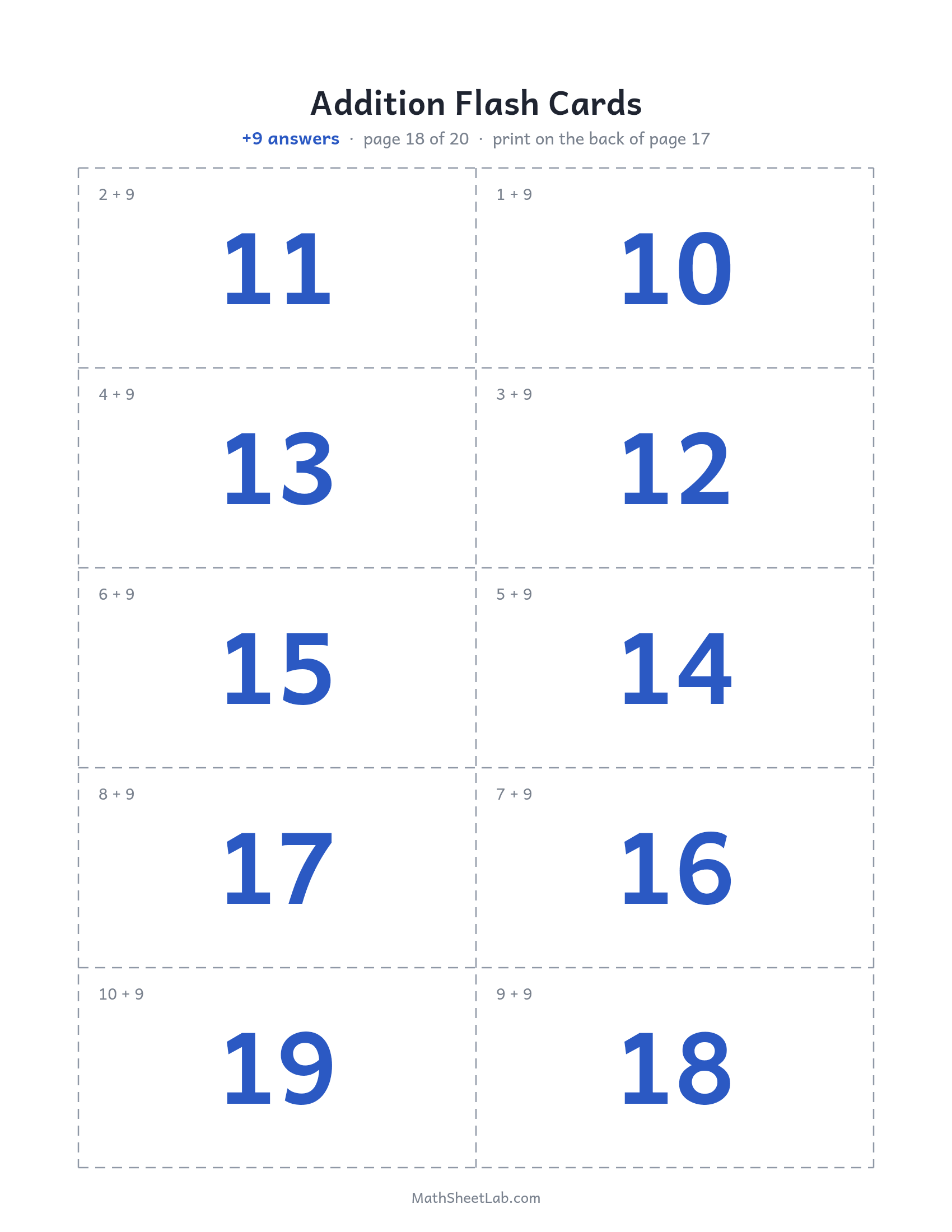
+9 answers
-
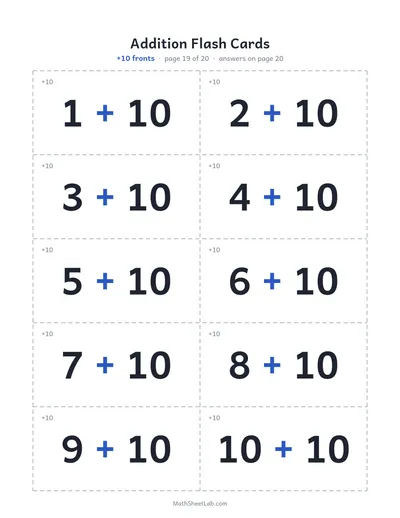
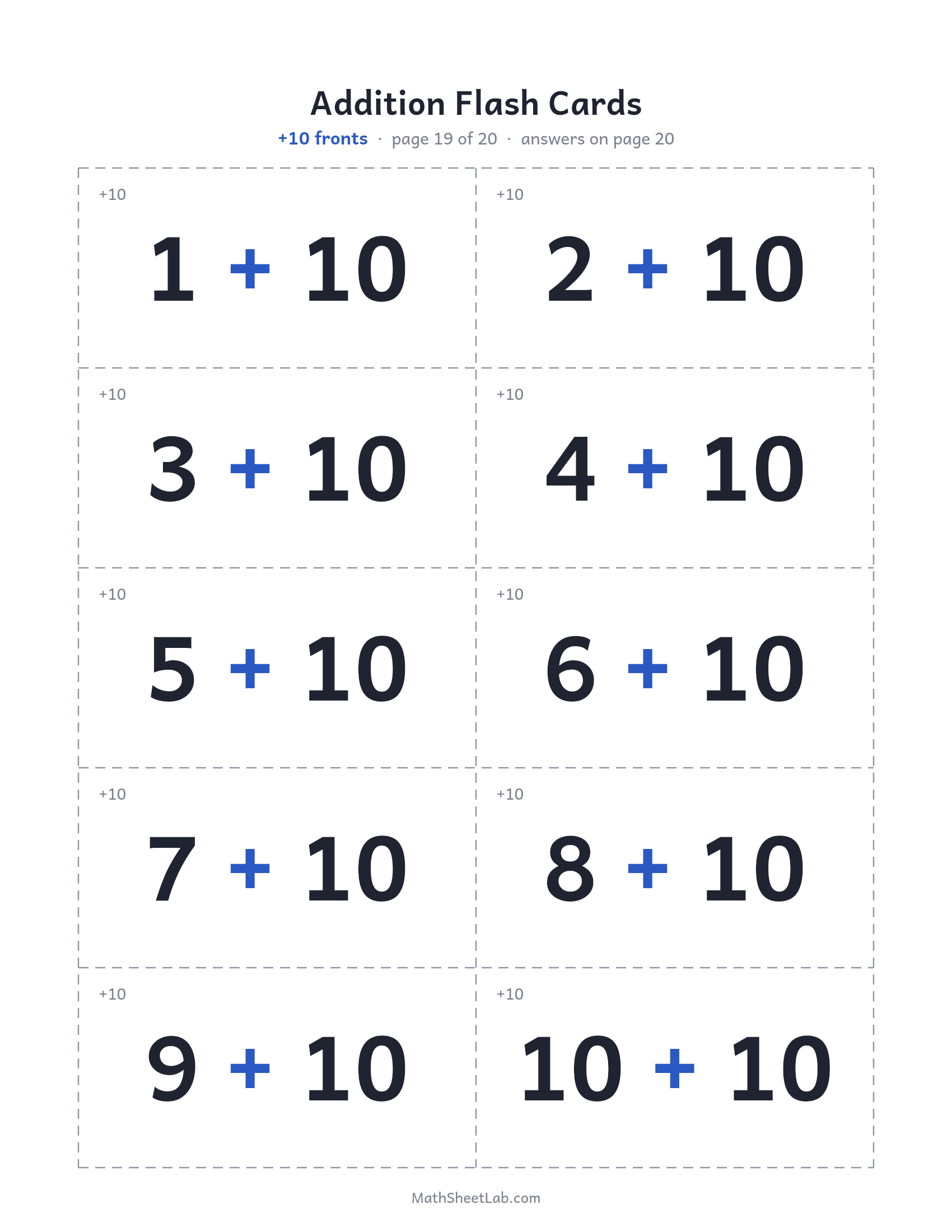
+10 fronts
-
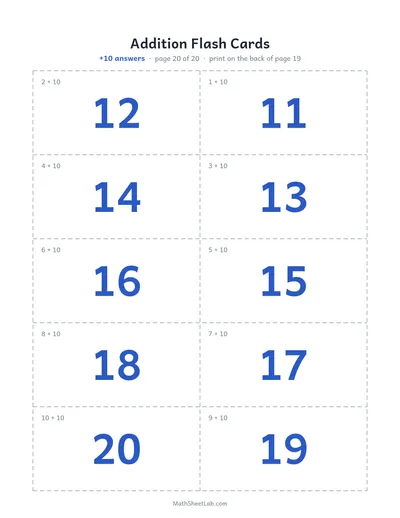
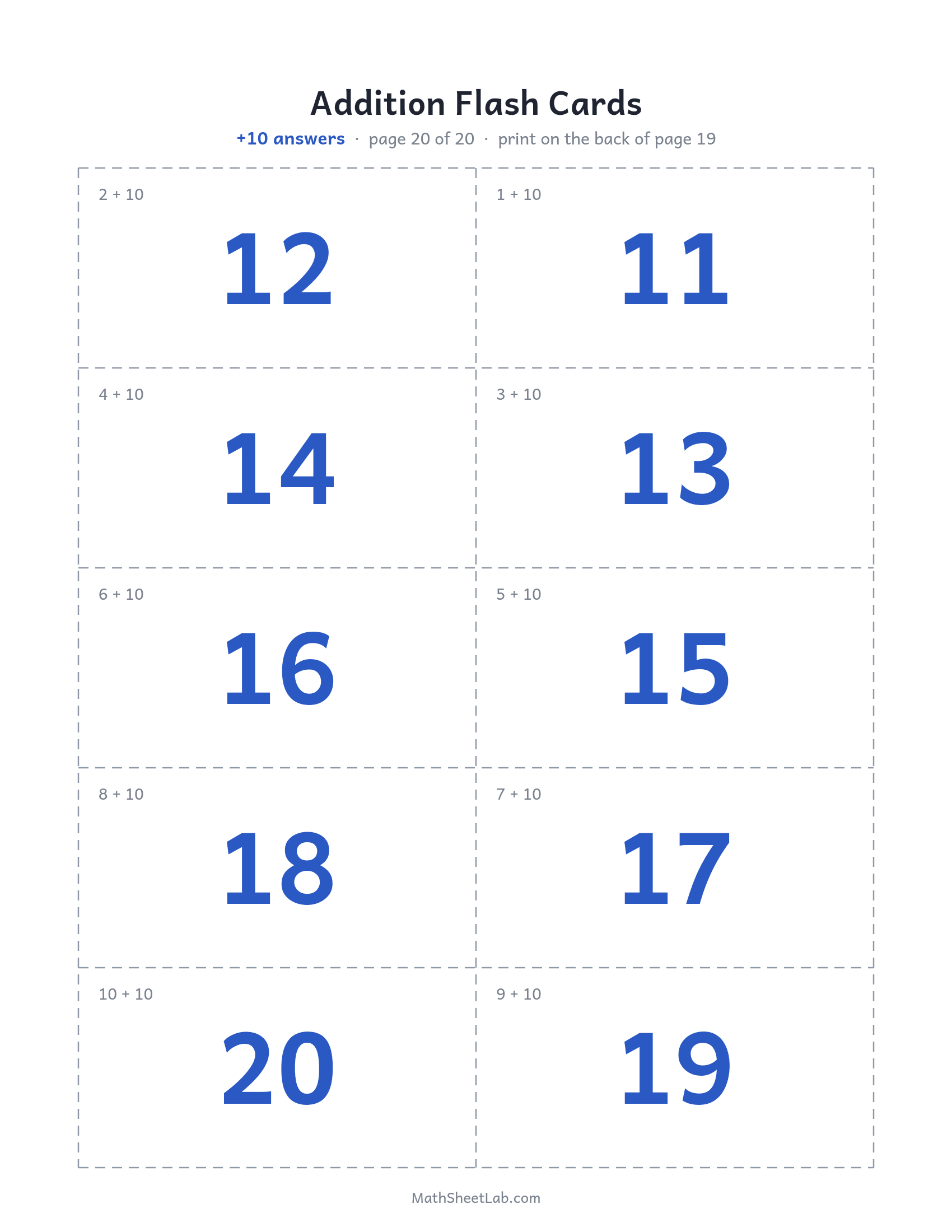
+10 answers
How to print it
- Download all the pages. Press “Download PDF (20 pages)” under the preview. The fronts and sums alternate, so the file is ready for two-sided printing. The buttons on each page in the gallery print a single sheet.
- Print two-sided, flip on long edge. In the print dialog choose two-sided printing with flip on long edge (some printers call it long-edge binding), so each sums sheet lands on the back of its own facts. With a one-sided printer, print every page and glue each sums sheet to the back of its facts, as the questions below explain.
- Cut out the cards. Cut along the dashed lines. Light card stock lasts far longer than copy paper.
About the addition flash cards
The set covers every sum of two numbers from 1 to 10, which is the addition-within-20 work of first and second grade. Each sheet holds the ten facts for one number being added (the +3 sheet runs from 1 + 3 to 10 + 3), so a child can get comfortable with +1 and +2 before meeting the +8s and +9s. The sheet after each set of facts holds the sums, mirrored so they land behind the right cards. Because 3 + 8 is on the +8 sheet and 8 + 3 is on the +3 sheet, every pair of different numbers turns up in both orders, and a child who knows one order already has the other.
Grade level: this chart is used in our 1st grade math worksheets and 2nd grade math worksheets collections.
Frequently asked questions
Why does the set start at 1 + 1 instead of 0 + 0?
Adding 0 is a single rule (any number plus 0 stays the same), so it does not need its own sheet of cards. Leaving it out keeps the set to 100 facts, with sums from 2 up to 20.
Why include the +10 facts?
Adding 10 has its own pattern: a one-digit number keeps its digit and gains a 1 in the tens place, so 3 + 10 is 13 and 7 + 10 is 17. The make-ten strategy leans on it, because 8 + 5 becomes 10 + 3 = 13. Every +n sheet already ends with 10 + n; the +10 sheet drills the same facts the other way around, from 1 + 10 to 10 + 10, and takes the set up to 20.
How do I print the addition cards double-sided?
Download the full PDF and choose two-sided printing with flip on long edge. Print pages 1 and 2 as a test before running all 20. With a one-sided printer, turn each sums sheet over sideways like a book page so its top stays at the top, glue its facts sheet face up on top with the top edges together, and cut along the dashed lines. Each sums card also has its fact in small type in the corner.
How should my child practice with them?
Start with the +1, +2 and +10 sheets: the first two are counting on, and the +10 cards walk through 11 to 20. Then pull out the doubles, one per sheet from 1 + 1 to 10 + 10, because near doubles like 6 + 7 lean on them. Sort cards into know and not-yet piles each session, start the next one with the not-yet pile, and time a shuffled stack once most cards are known.