Multiplication chart 1–50
All 2,500 products from 1×1 to 50×50, on four pages that tape together into a square poster.
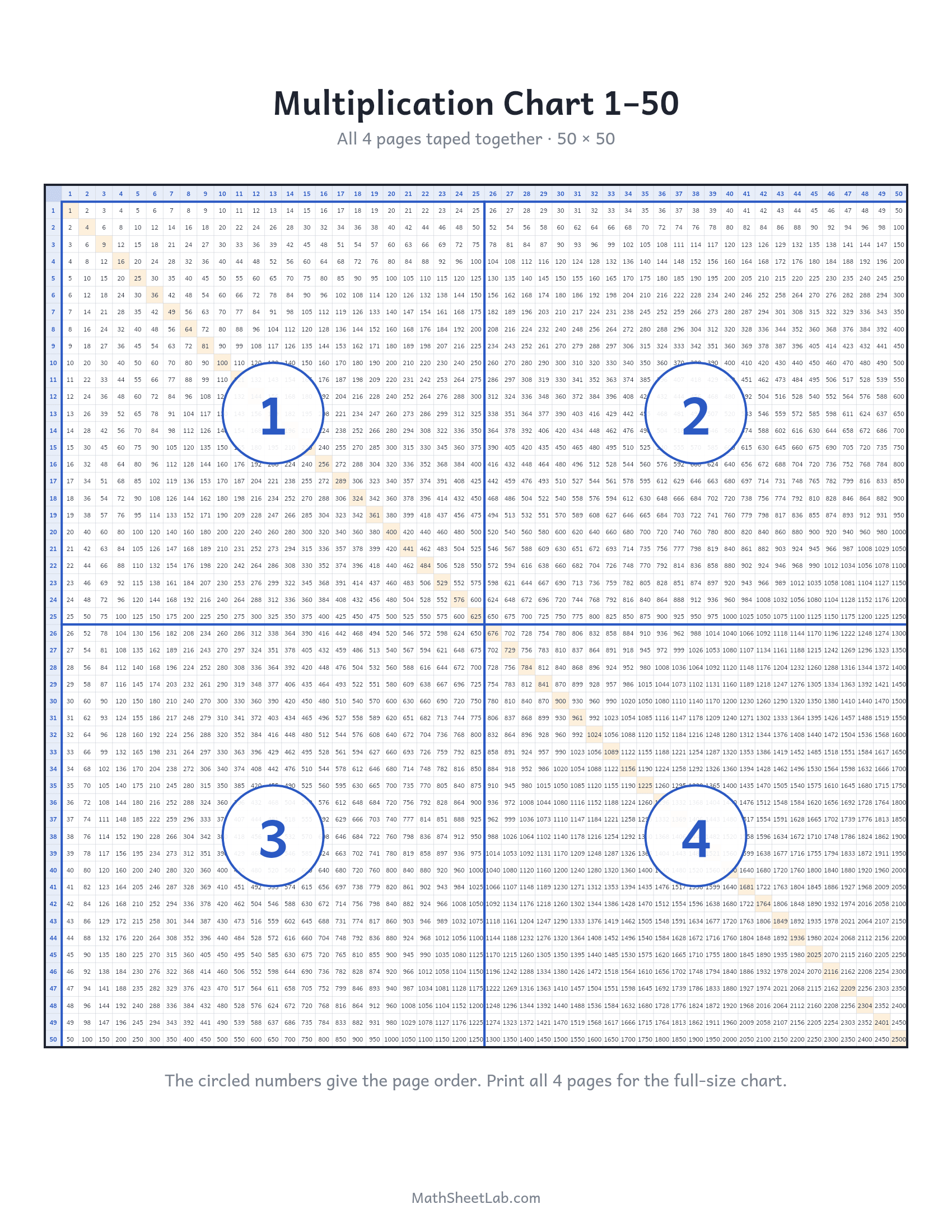
All 4 pages
Pages 1 and 2 form the top half of the poster (rows 1–25) and pages 3 and 4 the bottom half (rows 26–50), so trim the margins and tape them into a square two pages wide and two pages tall.
-
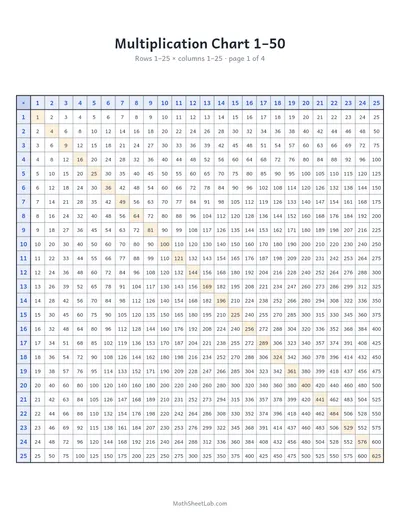
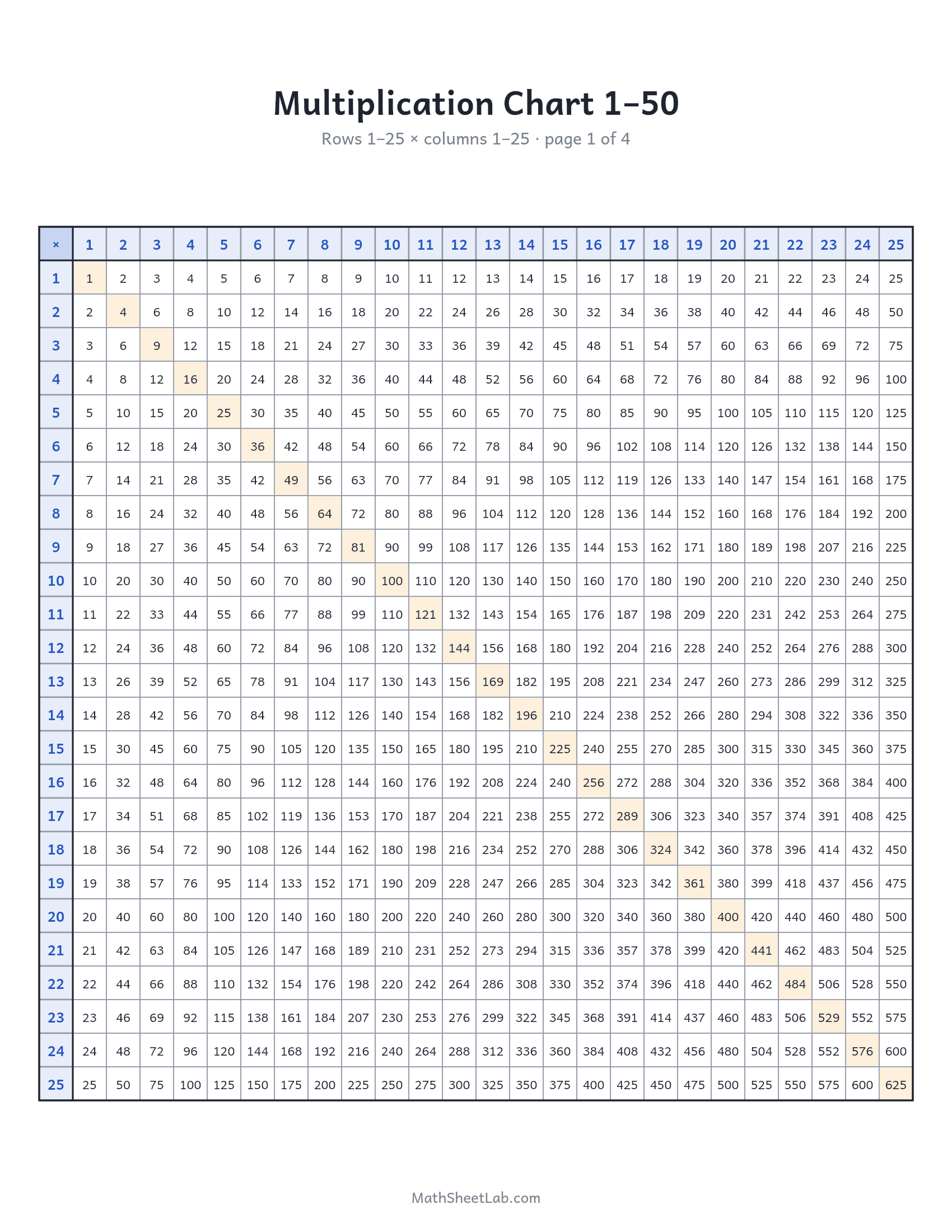
Page 1: rows 1–25 × columns 1–25
-
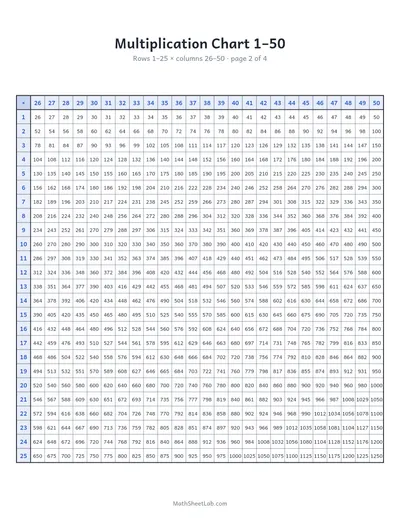
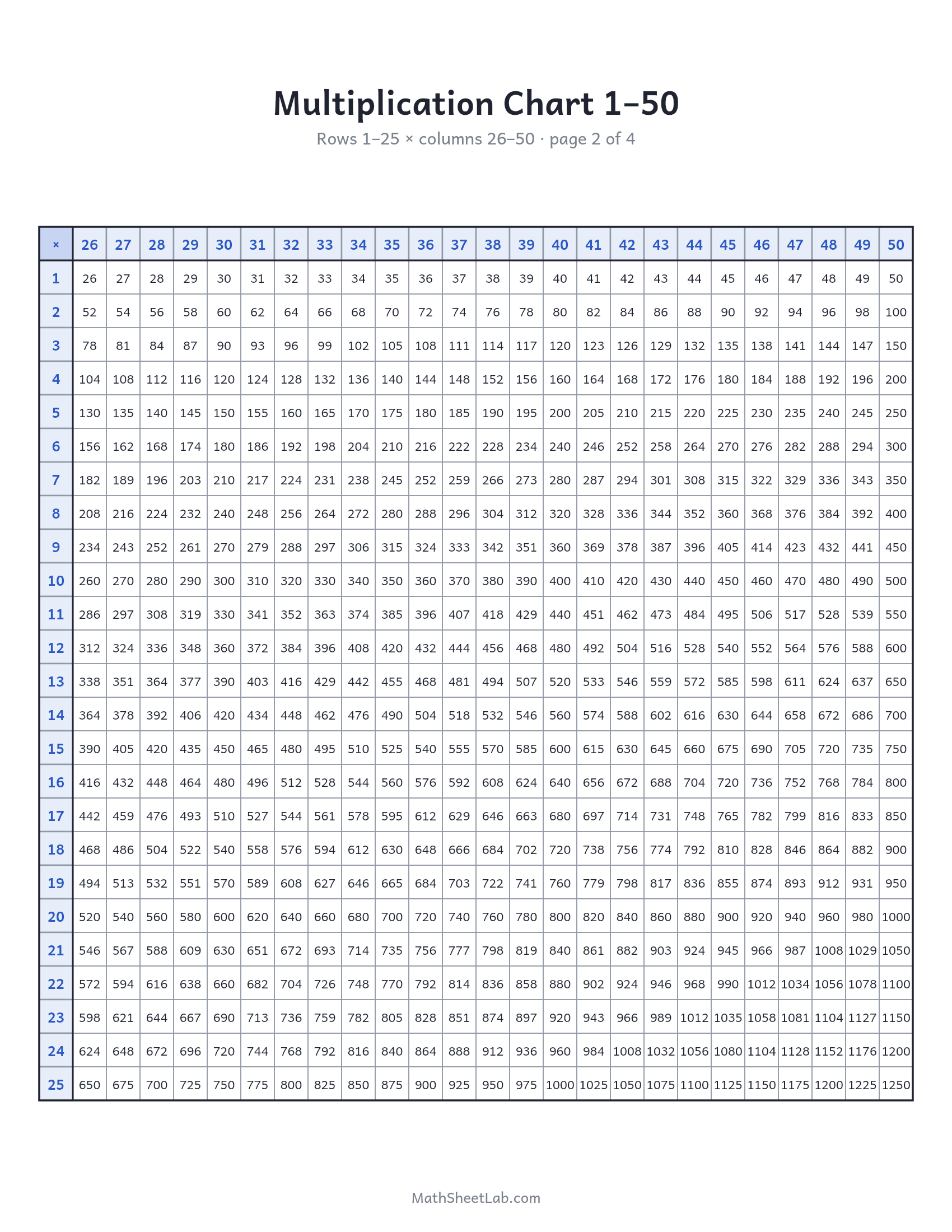
Page 2: rows 1–25 × columns 26–50
-
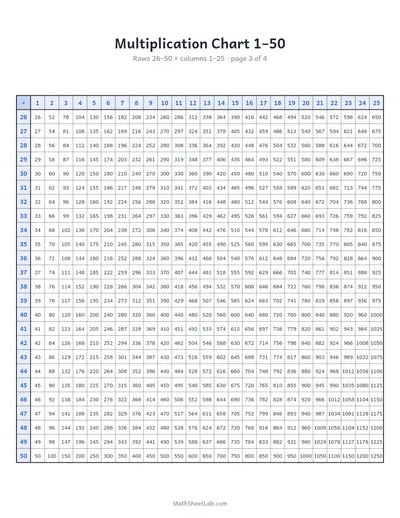
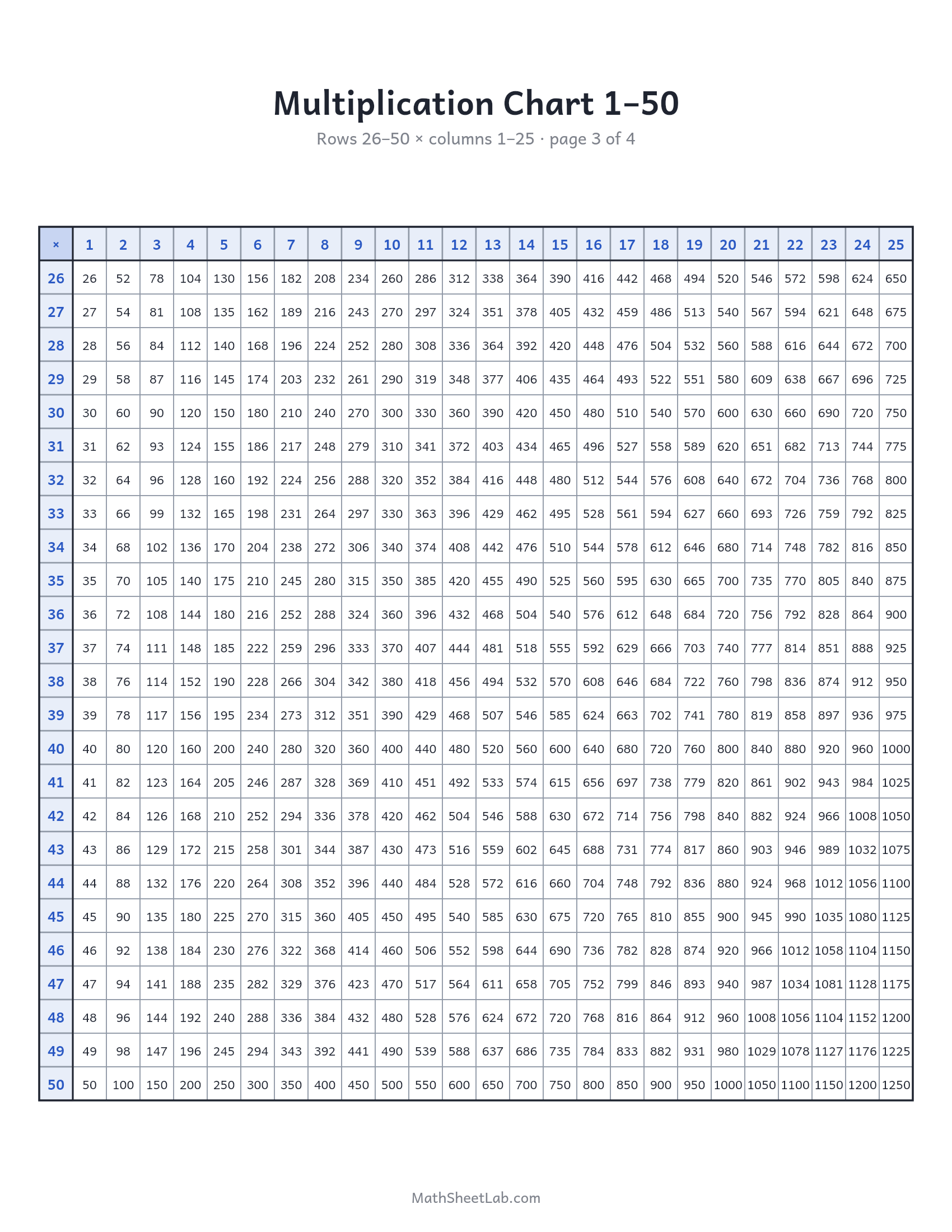
Page 3: rows 26–50 × columns 1–25
-
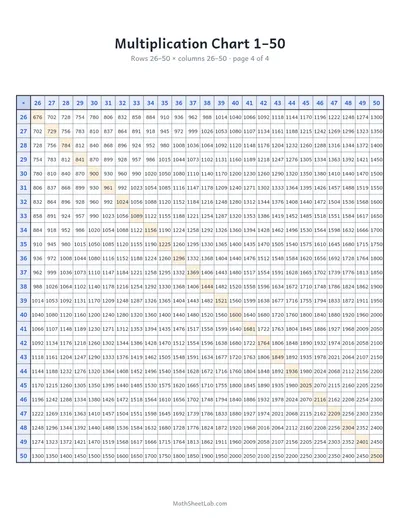
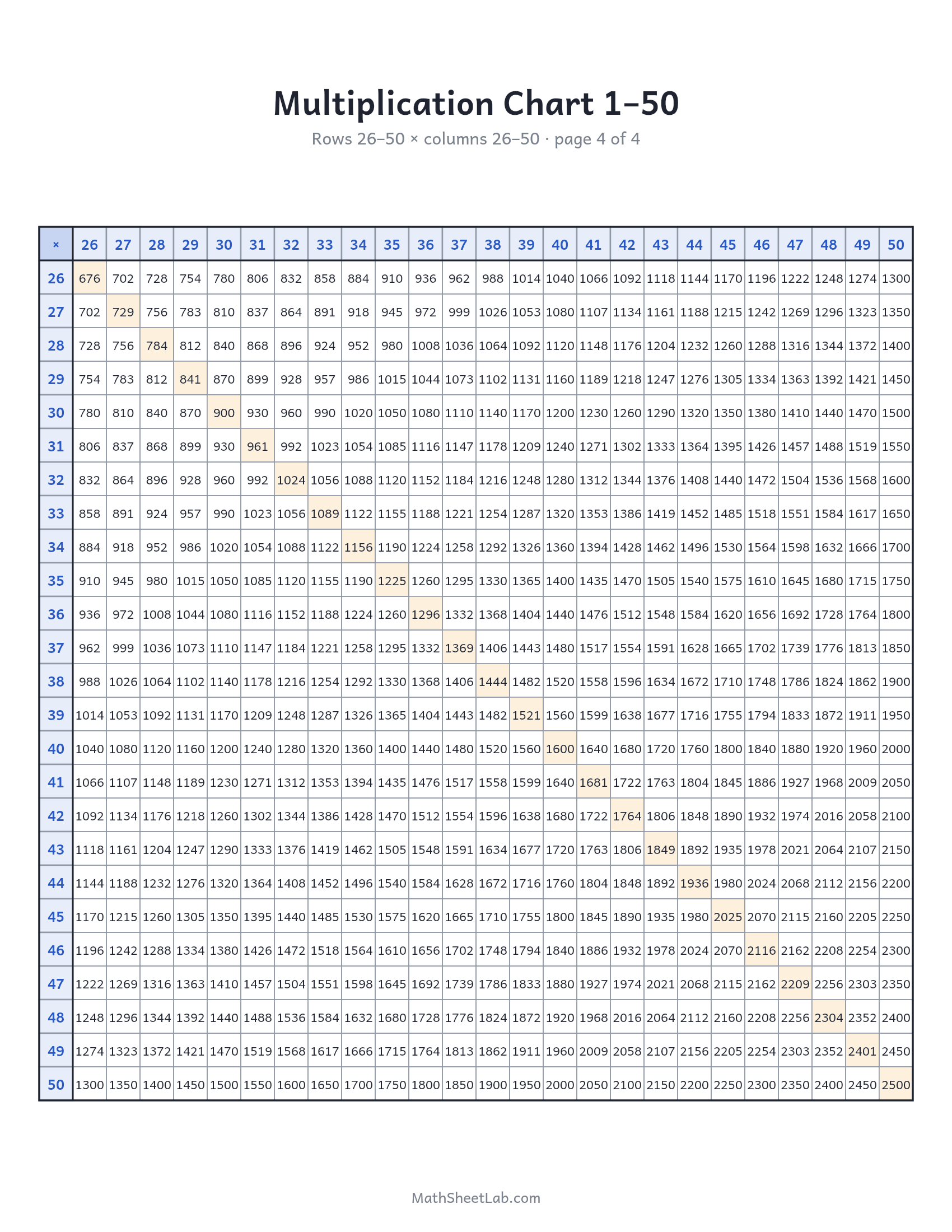
Page 4: rows 26–50 × columns 26–50
How to print it
- Download or print the set. Press Download PDF for all 4 pages in one file, or Print all 4 pages. Every page also has its own Print and PDF buttons in the gallery below.
- Fit to page. In the print dialog choose “Fit to page” — the chart is laid out for US Letter and scales cleanly onto A4.
- Copy freely. Print or photocopy as many as you need for home, classroom or tutoring use. It is free, with no sign-up.
About the multiplication chart 1–50
A 1–50 chart reaches the two-digit factors that keep turning up once the times tables are learned. Use it to check long multiplication with factors up to 50, or to find the least common multiple of 36 and 48 by running down both columns until they share a number (144). It takes four pages because 2,500 cells will not fit legibly on one sheet, and four pages trim and tape into a poster more than a foot square. Patterns worth pointing out: column 25 counts in 25s, the way you count quarters, all the way to 1,250; every product in row 50 ends in 00 or 50; and the square numbers down the shaded diagonal climb from 1 to 2,500 across pages 1 and 4.
Grade level: this chart is used in our 4th grade math worksheets collection.
Frequently asked questions
Why does the 1–50 chart take four pages?
There are 2,500 cells. Squeezed onto one Letter page, each would be about half as wide as on these four pages, too narrow for four-digit products. Four 25 × 25 blocks keep the numbers readable, and each page keeps its own headers so it can be used alone.
How do the four pages fit together?
Page 1 is top left (rows 1–25, columns 1–25), page 2 top right (columns 26–50), page 3 bottom left (rows 26–50) and page 4 bottom right. Trim the white margins and tape the seams from the back. For one continuous grid, also cut the row labels (the left column) off pages 2 and 4 and the column labels (the top row) off pages 3 and 4.
Where are the square numbers?
On the shaded diagonal, which only crosses pages 1 and 4: 1, 4, 9 up to 625 (25 × 25) on page 1, then 676 (26 × 26) up to 2,500 (50 × 50) on page 4.
Is there a bigger version?
Yes. The multiplication chart 1–100 uses the same 25 × 25 blocks over 16 pages. These four pages are its top-left corner (its pages 1, 2, 5 and 6), so if you have already printed these, the other twelve complete the 100 × 100 poster.