Prime numbers chart
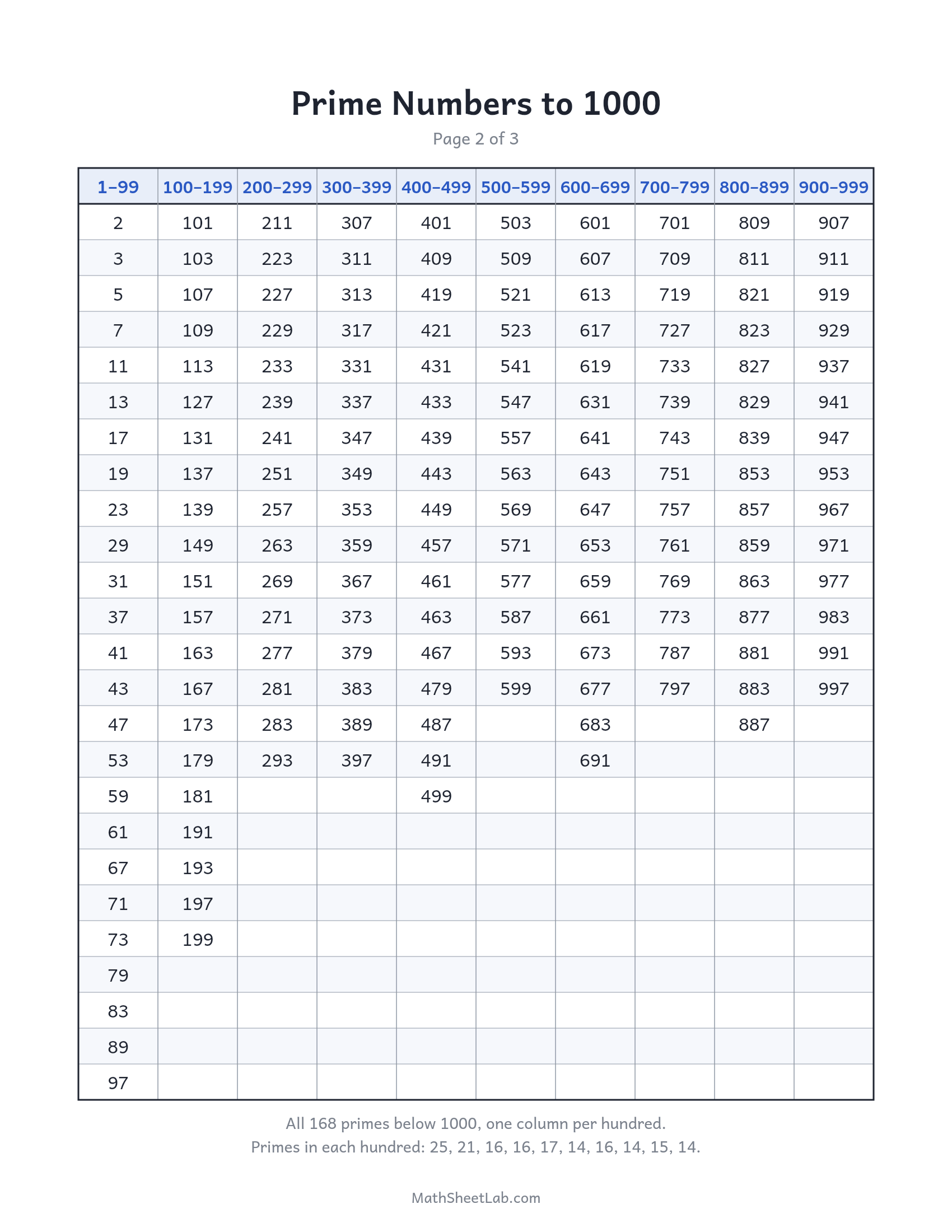
The 25 primes below 100 shaded on a hundreds chart, with a full list of primes to 1000 and a sieve sheet to work by hand.
All 3 pages
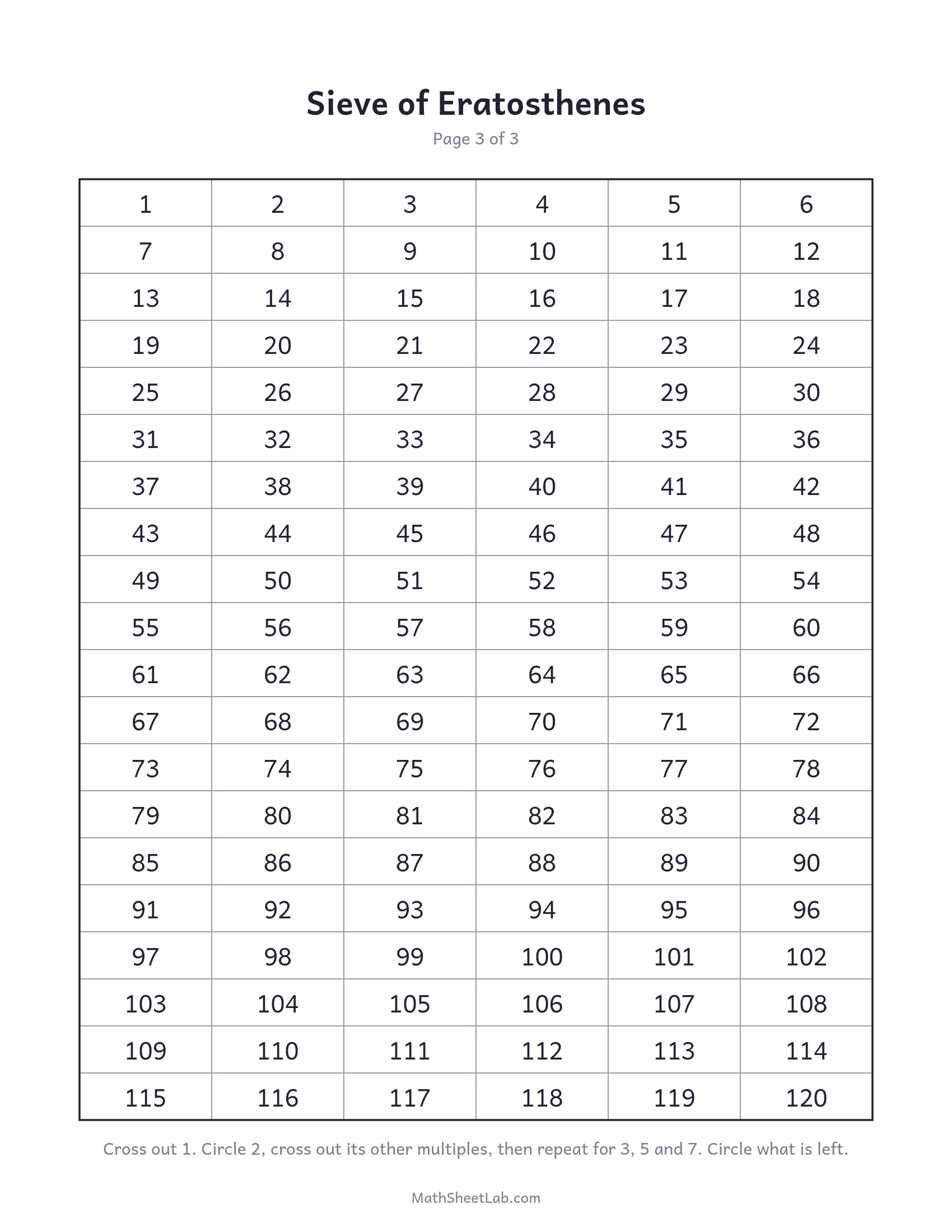
Page 1 is the shaded hundreds chart, page 2 lists every prime below 1000 by hundreds, and page 3 is an unshaded grid for running the sieve by hand.
-
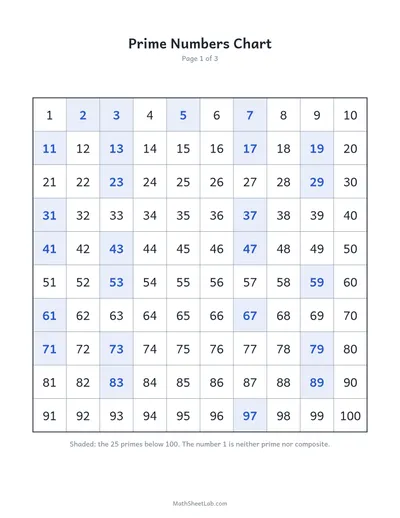
Primes to 100
-
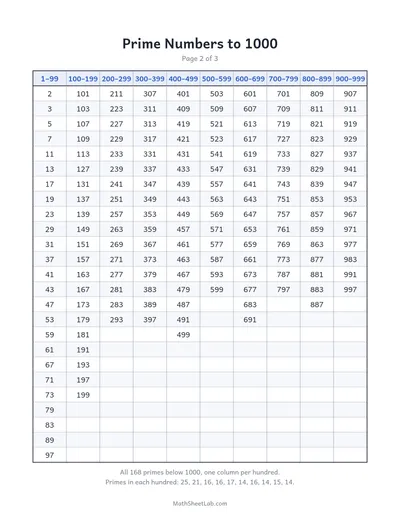
Primes to 1000
-
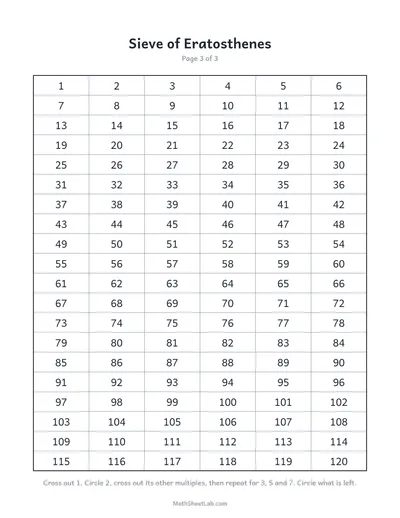
Sieve sheet
How to print it
- Open the print view. Press Print for a clean print-ready view of page 1, or download it as a PDF or PNG. The other pages are in the gallery below, with a button to download them all.
- Fit to page. In the print dialog choose “Fit to page” — the chart is laid out for US Letter and scales cleanly onto A4.
- Copy freely. Print or photocopy as many as you need for home, classroom or tutoring use. It is free, with no sign-up.
About the prime numbers chart
A prime number has exactly two factors, 1 and itself: 7 is prime, but 9 is not because 3 also divides it. Page 1 shades the 25 primes below 100, and two patterns stand out. The number 2 is the only even prime, and every prime after 5 ends in 1, 3, 7 or 9, so below the first row the shading falls in just four columns. Children find primes by hand with the Sieve of Eratosthenes: cross out 1, circle 2 and cross out the other multiples of 2, then do the same for 3, 5 and 7. Whatever is left is prime. Page 3 sets up the sieve on a six-wide grid from 1 to 120, and page 2 lists all 168 primes below 1000.
Grade level: this chart is used in our 4th grade math worksheets collection.
Frequently asked questions
Is 1 a prime number?
No. A prime has exactly two factors and 1 has only one, so it is neither prime nor composite. That is why 1 is the first number crossed out in the sieve.
How many prime numbers are there below 100?
There are 25: 2, 3, 5, 7, 11, 13, 17, 19, 23, 29, 31, 37, 41, 43, 47, 53, 59, 61, 67, 71, 73, 79, 83, 89 and 97. Below 1000 there are 168.
Why does the sieve stop at 7?
Any composite number up to 120 has a prime factor of 7 or less, because the next prime is 11 and 11 × 11 is already 121. Once the multiples of 2, 3, 5 and 7 are crossed out, every number left except 1 is prime.
Why is the sieve sheet six columns wide?
The multiples of 2 and 3 fill four whole columns, so after the sieve every prime except 2 and 3 sits in the first or fifth column: one more or one less than a multiple of 6.